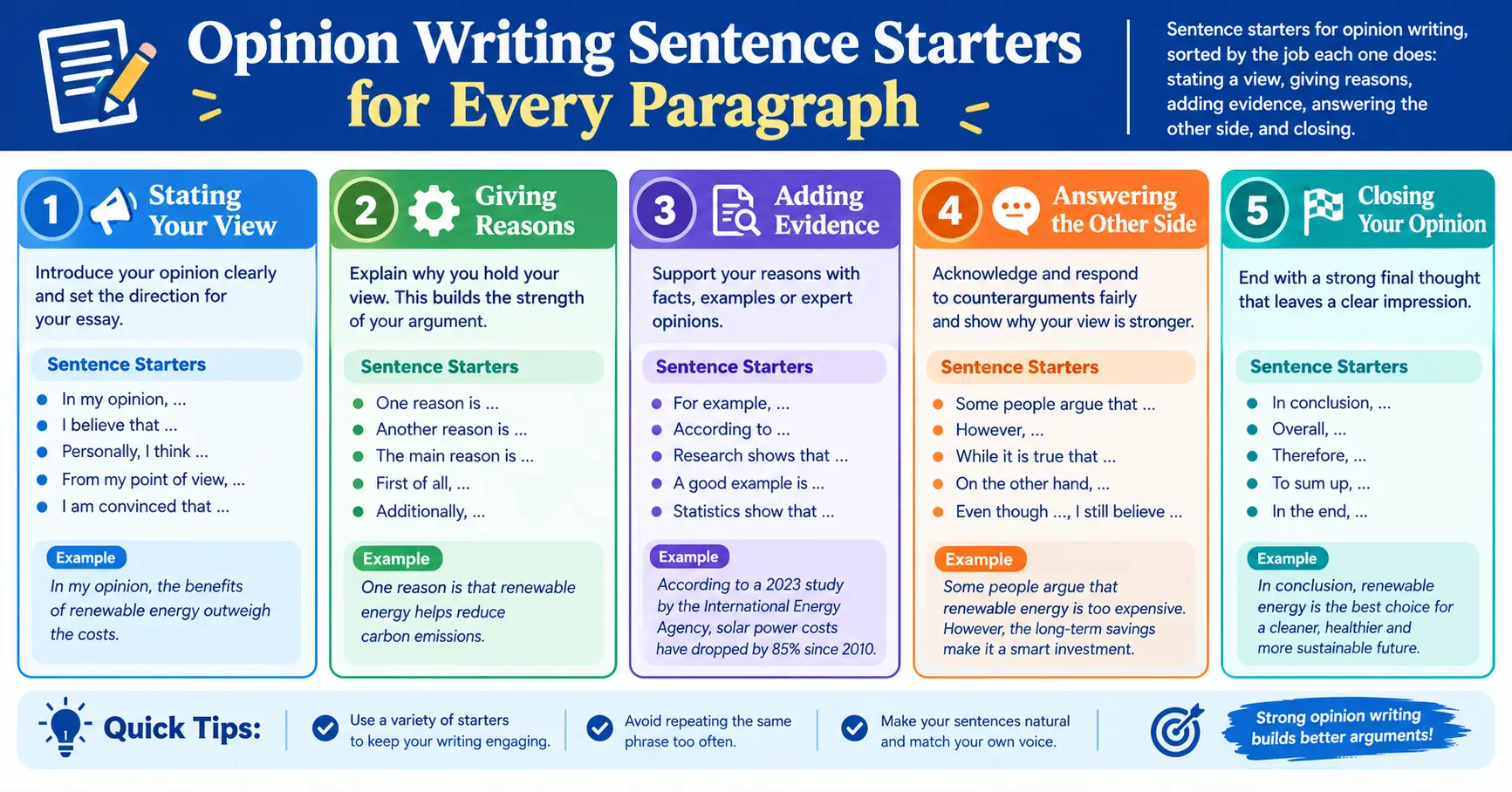
Most lists of sentence starters are one long jumble. That is why students pick the wrong one and end up writing “In conclusion” in the middle of a paragraph.
These are sorted by what the sentence needs to do. Find the job first, then pick the starter.
1. Stating your opinion
Use one of these once, at the start. Not four times.
- I believe that…
- In my opinion…
- I think that… because…
- The best choice is… because…
- Schools should…
- Everyone should…
- It is clear that…
- I strongly believe that…
Note for older students: by middle school, dropping “I think” makes writing stronger, not weaker. “Schools should start later” is more confident than “I think schools should start later”. Save the phrase for when you genuinely need to mark it as opinion.
2. Giving your first reason
- One reason is…
- To begin with…
- First of all…
- The main reason is…
- My first reason is…
3. Adding more reasons
- Another reason is…
- In addition…
- Also…
- What is more…
- Not only that, but…
- A second reason is…
4. Giving evidence or an example
This is the group most students skip, and it is where the marks are.
- For example…
- For instance…
- According to…
- Research shows that…
- A good example of this is…
- This is shown when…
- The article states that…
5. Explaining what the evidence means
Even more often skipped. Evidence does not speak for itself.
- This shows that…
- This proves that…
- This matters because…
- What this means is…
- As a result…
- That is why…
6. Answering the other side
Nothing lifts an opinion piece faster than admitting the other side exists and answering it.
- Some people think… but…
- Others may argue that… however…
- It is true that… even so…
- Although some believe… I still think…
- Critics say… but they forget that…
7. Concluding
Once, at the end.
- In conclusion…
- For these reasons…
- All in all…
- This is why I believe…
- To sum up…
- That is why… should…
A structure that works
For younger writers, five paragraphs in this order:
- Opinion. State it. One or two sentences.
- Reason one, with an example, then what the example shows.
- Reason two, same shape.
- The other side, and your answer to it.
- Conclusion. Restate the opinion in different words.
The fourth paragraph is what separates an average opinion piece from a good one.
The mistake starters cause
Sentence starters are training wheels, and training wheels come off.
The problem: a student who has memorised the list writes “Firstly… Secondly… Thirdly… In conclusion…” and the piece reads like a form being filled in.
Two ways to avoid that.
- Vary the position. Not every sentence needs a starter at the front. “Schools should start later because teenagers need sleep” is stronger than “One reason is that teenagers need sleep.”
- Aim for one starter per paragraph, not per sentence. The starter marks the turn in the argument. If every sentence is marked, none of them stand out.
For teachers
The two groups worth drilling are evidence and explaining the evidence. Most students can state an opinion and give a reason. Far fewer connect a reason to a piece of evidence and then say what it shows.
A short exercise that works: give students a reason and an example, and ask only for the sentence that links them. Nothing else.
Where to go next
- How to write clearly in English, the habits behind good structure
- Writing exercises for adults, several of which suit older students
- 9th grade vocabulary words for stronger word choice
- Check a paragraph for grammar and clarity
Questions people ask
What is a sentence starter?
A short phrase at the start of a sentence that signals its job, such as introducing a reason or giving an example.
Are sentence starters good or bad for writing?
Good early, limiting later. They teach structure, but a piece where every sentence begins with one reads mechanically. One per paragraph is a reasonable target.
What are the best opinion sentence starters for elementary school?
“I believe that”, “One reason is”, “For example”, “This shows that”, and “In conclusion”. Those five cover a full paragraph structure.
How do I write a counterargument sentence?
Start with what the other side thinks, then turn: “Some people think homework helps, but studies show it makes little difference before high school.”
For how persuasive structure is described formally, see the overview of rhetoric on Wikipedia.