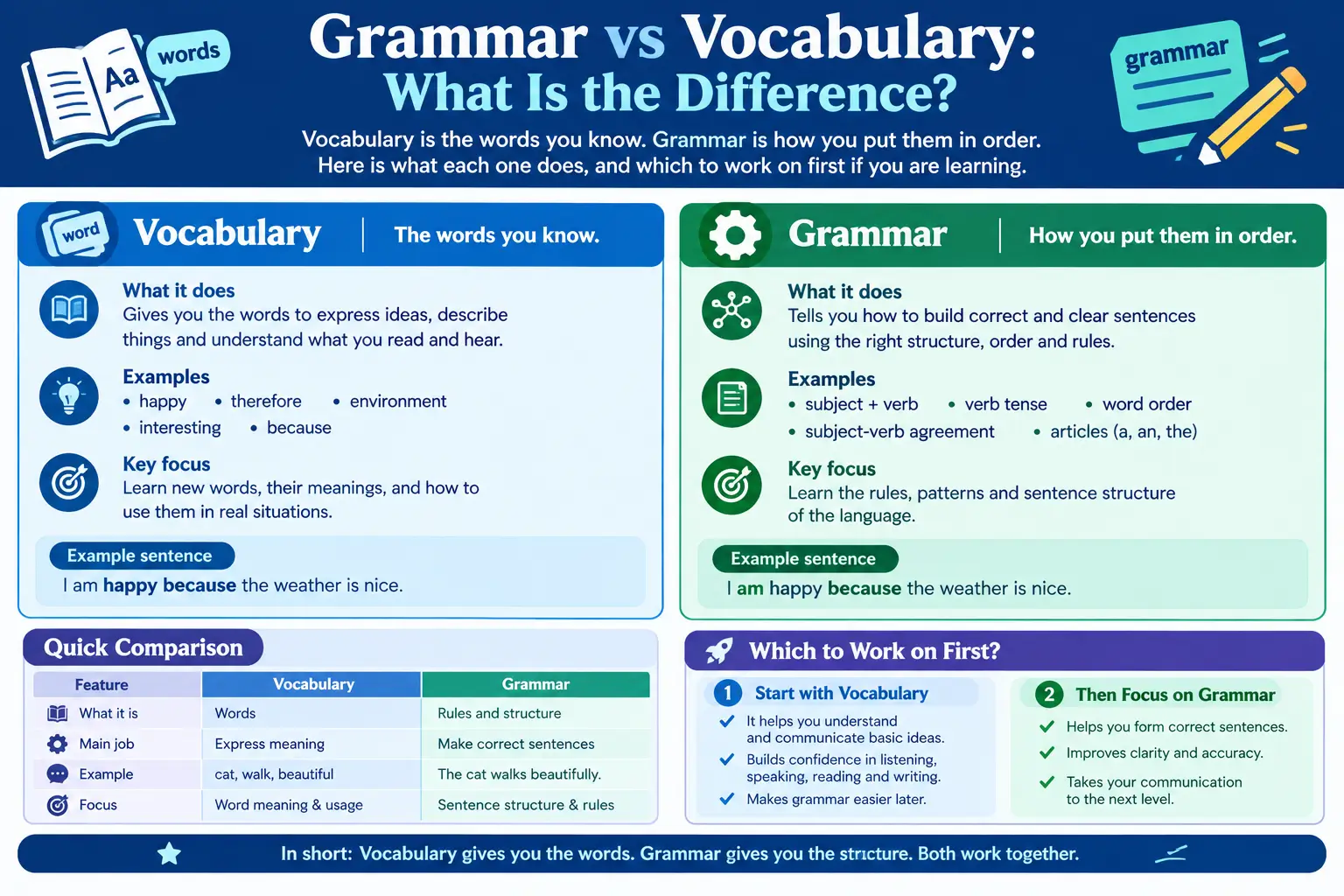
Vocabulary is the words you know. Grammar is the rules for putting those words in an order that makes sense.
Words are the bricks. Grammar is how they stack.
Why you need both, shown quickly
Take four words: dog, bit, the, man.
That is vocabulary. Four words, and on their own they mean almost nothing.
Now add grammar:
- The dog bit the man.
- The man bit the dog.
Same four words. Completely different events. The difference is entirely word order, which is grammar.
Now the reverse. Perfect grammar, no vocabulary:
- The thing did the thing to the thing.
Grammatically flawless. Meaningless.
That is the whole relationship. Vocabulary carries the meaning. Grammar arranges it so the meaning survives the trip to the reader.
What each one actually covers
| Vocabulary | Grammar | |
|---|---|---|
| What it is | The words you know and can use | The rules for combining and changing them |
| Includes | Meanings, synonyms, opposites, which words go together | Word order, verb tense, agreement, plurals, articles |
| Example question | What does ubiquitous mean? | Is it she go or she goes? |
| How you build it | Reading widely, then using words | Noticing patterns, then practising them |
| What a gap sounds like | You cannot find the word you want | You have the words but they come out in the wrong shape |
Which should you learn first?
If you are learning English, the honest answer is vocabulary first, by a wide margin.
Here is why. A sentence with the right words and broken grammar usually still gets through:
“Yesterday I go shop, buy three bread.”
Wrong tense, wrong plural, missing words. But you understood it completely.
Now flip it. Perfect grammar, missing words:
“Yesterday I went to the shop and bought three… um…”
The sentence stops. Communication fails.
Vocabulary is what lets you say something. Grammar is what makes it sound right. In that order.
This is also why very small children speak in vocabulary long before grammar. “More milk” has no grammar at all and works perfectly.
When grammar becomes the priority
Vocabulary first does not mean grammar never. Grammar becomes the thing to fix in three situations.
- When you are being marked. Exams and essays penalise grammar directly and visibly.
- In professional writing. A grammar error in a job application costs more than a small vocabulary, fairly or not.
When the error changes the meaning. “I have lived here for three years” and “I lived here for three years” mean different things. One says you still live here. That is grammar carrying meaning, not just polish.
What about spelling and punctuation?
Neither is grammar, though people group them.
- Spelling is which letters go in a word.
- Punctuation is the marks that show where to pause and stop.
- Grammar is how words change and combine.
All three, plus capitalisation and usage, are usually taught together as grammar conventions.
How to work on both at once
The efficient answer is to stop treating them as separate subjects.
- Learn vocabulary in full sentences, never in lists. A word on its own teaches you a meaning. A word in a sentence teaches you the meaning and the grammar around it, at the same time. You learn that you depend on something, not depend of it, without studying prepositions at all.
- Read slightly above your level. Both vocabulary and grammar patterns arrive together and free.
- Write something short every day. Writing is where a gap in either becomes obvious, because you cannot skip past a word you do not have.
Where to go next
- English grammar in plain English, the rules explained without jargon
- Build your English vocabulary, the method and the common traps
- Grammar conventions, where spelling and punctuation fit in
- Check a sentence for both grammar and word choice
Questions people ask
What is the difference between grammar and vocabulary?
Vocabulary is the words you know. Grammar is the set of rules for putting them in an order that makes sense. Vocabulary carries meaning; grammar arranges it.
Which is more important, grammar or vocabulary?
Vocabulary, for being understood. A sentence with the right words and broken grammar usually still communicates. A sentence with perfect grammar and a missing word does not.
Is spelling part of grammar?
No. Spelling is which letters go in a word. Grammar is how words change and combine. Both sit under the wider heading of writing conventions.
Can you have good grammar and bad vocabulary?
Yes, and it is common in learners who studied from textbooks. The sentences are correct but simple, because there are not enough words available to say anything complicated.
For how linguists separate the two, see the overview of grammar on Wikipedia.