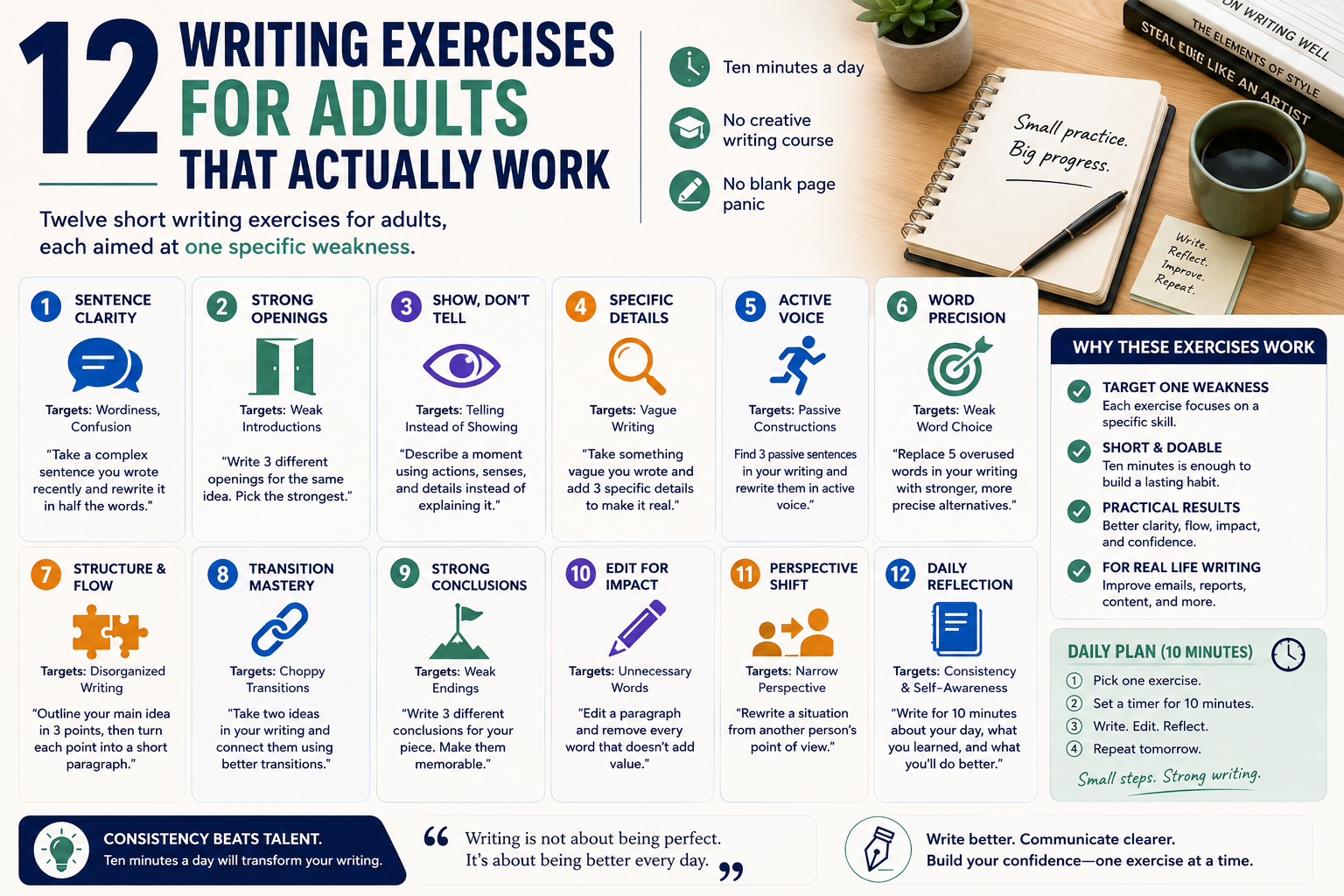
Most writing advice for adults is either a creative writing course you do not have time for, or a list of prompts that produce pages nobody reads.
These twelve are different. Each one targets one specific weakness, takes about ten minutes, and produces something you can measure.
Pick the exercise that matches the problem you actually have.
If your sentences run on
1. The one-breath test
Take a paragraph you wrote last week. Read it aloud. Every time you run out of breath, put a full stop there.
Most people find two or three sentences hiding inside every long one. This is the fastest improvement available to any adult writer, and it costs nothing.
2. Cut by a third
Take 300 words you have written. Get them to 200 without losing any meaning.
You will discover that the first cuts are painless. Adverbs go. “In order to” becomes “to”. Whole clauses turn out to be repeating the sentence before. The exercise teaches you what padding feels like from the inside.
If your writing sounds stiff
3. Write it as a text message first
Before writing a formal email, write the message as if you were texting a friend. Then formalise only the words, not the structure.
Stiff writing almost always comes from planning the shape formally. The shape should be plain; only the vocabulary changes.
4. Remove every passive
Take a page and find every sentence where the doer is missing or moved to the end. “Mistakes were made” becomes “we made mistakes.”
Do not do this permanently. Do it once as an exercise so you can see how much you rely on it.
If you cannot start
5. Write the middle first
Skip the introduction entirely. Write the part you already know, then work outwards.
The blank page problem is almost always an introduction problem. Introductions are easier to write once the thing they introduce exists.
6. Ten minutes, no backspace
Set a timer for ten minutes and write without deleting anything. Typos stay. Bad sentences stay.
This separates drafting from editing. Most adults who “cannot write” are trying to do both at once, which is like driving with the handbrake on.
If your writing is unclear
7. Explain it to a ten year old
Take your most technical paragraph and rewrite it so a ten year old could follow it. Keep the meaning exactly.
If you cannot, you have found something you do not understand as well as you thought. That is the real value of the exercise.
8. The so-what test
After each paragraph, write “so what?” and answer it in one sentence.
If you cannot answer, the paragraph is doing no work. This is the single most effective structural exercise for reports and proposals.
If your vocabulary feels flat
9. Ban your five favourite words
List the five words you overuse. Common culprits: very, really, actually, just, thing. Write 200 words without any of them.
The point is not that those words are bad. It is that banning them forces you to find the precise word underneath.
10. Replace every “very”
Go through a page and replace each “very plus adjective” with one word. Very tired becomes exhausted. Very big becomes enormous.
You will not keep all of them, and you should not. But you will find two or three that are genuinely better.
If you want to improve fastest
11. Copy a paragraph by hand
Find a paragraph by a writer you admire. Copy it out by hand, word for word.
This feels pointless and is not. Copying forces you to notice sentence length, punctuation and rhythm at a level reading never reaches. Musicians learn this way. Writers rarely try it.
12. Rewrite yesterday’s email
Take one email you sent yesterday and rewrite it to be half as long and clearer.
This is the only exercise on the list using real stakes, real audience, and real subject matter, which is why it improves your actual writing faster than any invented prompt.
How to actually keep this up
- Ten minutes, not an hour. Adults abandon writing practice because they schedule too much of it.
- One exercise at a time, for a week. Rotating through all twelve teaches you nothing. Doing exercise 1 every day for a week changes how you write sentences permanently.
- Use real material. Your own old emails and reports beat invented prompts, because you already care about them and you can see the improvement.
Where to go next
- How to write clearly in English, the six habits behind these exercises
- Twelve common English mistakes and the test for each
- Check a paragraph for grammar, spelling, and wordy phrasing
- Readability score to see your average sentence length
Questions people ask
How long before writing exercises make a difference?
The one-breath test changes your sentences the same day. Structural habits take a few weeks of ten-minute sessions.
Do I need to write creatively to improve at work writing?
No. Exercises 1, 2, 8, and 12 use your own work material and improve business writing directly. Creative prompts are optional.
Is it better to write a lot or to edit carefully?
Both, but separately. Exercise 6 is for drafting, and exercise 2 is for editing. Doing them at the same time is what makes writing feel hard.
For the standards professional writers use for clarity, see the federal plain language guidelines.