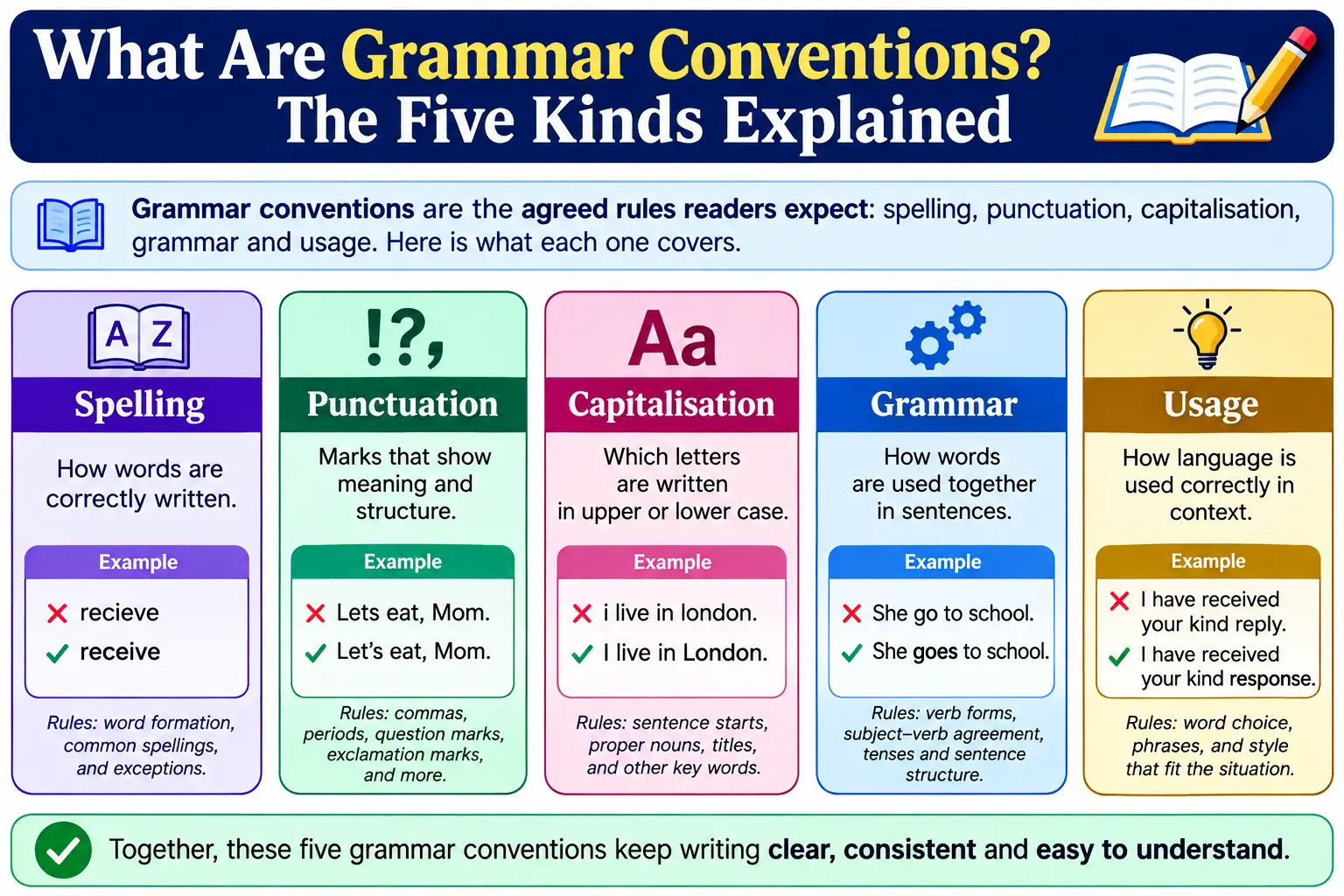
Grammar conventions are the agreed rules of written English that readers expect you to follow: spelling, punctuation, capitalisation, grammar and usage.
The word convention is doing real work there. A convention is something people agreed on, not something that was proved. Driving on the right is a convention. So is starting a sentence with a capital letter.
That matters, because it explains why conventions change over time and why they differ between countries, while still being worth following.
The five kinds
Teachers and marking rubrics usually split conventions into five groups. Almost every correction you have ever received belongs to one of them.
1. Spelling
Which letters go in which order.
- definitely, not definately
- separate, not seperate
- grammar, not grammer
2. Punctuation
The marks that show a reader where to pause, stop, and group ideas.
- Full stops, commas, question marks
- Apostrophes for ownership and contractions
- Quotation marks, colons, semicolons
Punctuation is not decoration. “Let’s eat, Grandma” and “Let’s eat Grandma” differ by one comma and one life.
3. Capitalisation
Which words start with a capital letter.
- The first word of a sentence
- Names of people, places, days, months, brands
- The pronoun I, always, wherever it appears
4. Grammar
How words change form and combine.
- Subject and verb agreement: she goes, not she go
- Verb tense: she walked, not she walk yesterday
- Pronouns matching what they replace
5. Usage
Which word is the right one, even when both are spelled correctly.
- affect or effect
- fewer or less
- lie or lay
Usage is the group people find hardest, because a spellchecker cannot help. Both words exist; only one is right.
Conventions are not the same as style
This distinction saves a lot of pointless arguments.
- A convention is broadly agreed. Writing “she go” is wrong in every variety of English.
- A style choice is a house rule. Whether you write the Oxford comma in “red, white, and blue” is a style choice. Newspapers usually leave it out. Academic publishers usually keep it. Neither is an error.
If someone corrects you and cannot say which of the five groups the rule belongs to, they may be enforcing a preference rather than a convention.
Why conventions matter even though they are arbitrary
The rules were not handed down. They were settled by use, and they keep shifting.
But that does not make them optional, for a practical reason: conventions carry no meaning, so breaking them is pure noise. A reader who trips over a misspelling spends a moment on your spelling instead of your point. You paid attention for nothing.
Following conventions is not about correctness for its own sake. It is about keeping the reader’s attention on what you are actually saying.
Which conventions to fix first
If you want the biggest improvement for the least effort, in order:
- Subject and verb agreement. The most noticed error in written English.
- Apostrophes. Its and it’s, plus never using an apostrophe to make a plural.
- Sentence boundaries. Full stops in the right places. Run-on sentences make everything else look worse.
- Commonly confused pairs. Their, there, they’re and your, you’re.
- Spelling of the twenty words you personally get wrong. Not a general list. Yours.
That last one is the most useful and the most skipped. Paste your own old writing into a checker and find out which words you actually misspell, rather than guessing.
Where to go next
- English grammar in plain English, covering group four in detail
- Twelve common English mistakes, one for each convention group
- Is vs are, the agreement rule in full
- Check your writing for spelling, grammar and word choice
Questions people ask
What are the five writing conventions?
Spelling, punctuation, capitalisation, grammar and usage. Nearly every written correction falls into one of these.
Is punctuation part of grammar?
Not strictly. Grammar is about how words change and combine. Punctuation is a separate convention about marks on the page. Marking rubrics usually group them under conventions, which is why they get confused.
Do grammar conventions change?
Yes, slowly. Rules like never splitting an infinitive have largely faded. Core conventions such as subject-verb agreement have been stable for centuries.
What is the difference between a convention and a style rule?
A convention is broadly agreed across all English. A style rule is a house preference, such as whether to use the Oxford comma. Breaking a convention is an error; breaking a style rule is a choice.
For how English writing conventions developed and became standardised, see standard English on Wikipedia.