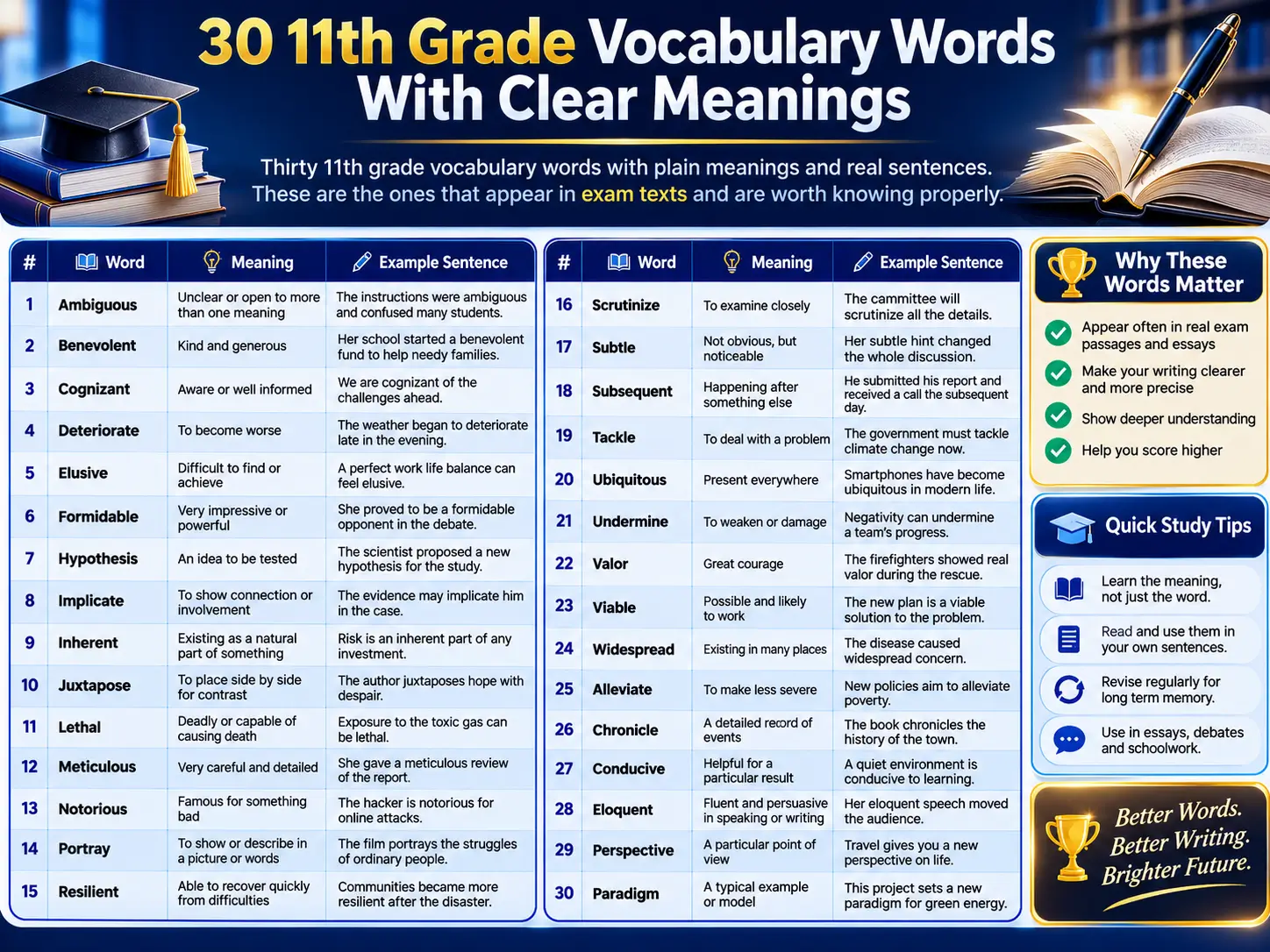
Eleventh grade is where vocabulary starts doing real work. The words below are not decoration. Each one lets you say something in one word that would otherwise take a sentence, which is exactly what a strong essay needs.
11th Grade Vocabulary Words list
| Word | What it means | Used in a sentence |
|---|---|---|
| aberration | a one-off departure from the normal pattern | The low score was an aberration, not a trend. |
| acquiesce | to agree quietly, often reluctantly | She acquiesced rather than argue again. |
| alacrity | cheerful eagerness | He accepted the invitation with alacrity. |
| anomaly | something that does not fit the pattern | The result was an anomaly worth investigating. |
| arduous | needing hard, sustained effort | The climb was arduous. |
| austere | plain and severe, with no comfort | The room was austere. |
| banal | boring because it is so ordinary | His speech was full of banal advice. |
| capitulate | to give in after resisting | The company capitulated to the demands. |
| circumspect | careful, thinking about consequences | Be circumspect about what you post. |
| clandestine | secret, usually because it is not allowed | They held clandestine meetings. |
| cogent | clear and convincing | She made a cogent argument. |
| conciliatory | trying to end a disagreement | His conciliatory tone calmed the room. |
| disdain | open contempt for something | He looked at the essay with disdain. |
| ephemeral | lasting a very short time | Fame is ephemeral. |
| equivocate | to speak vaguely to avoid committing | The witness equivocated under questioning. |
| fastidious | fussy about detail and cleanliness | She is fastidious about her notes. |
| garrulous | talking far too much | Our garrulous neighbour kept us an hour. |
| hackneyed | worn out from overuse | “At the end of the day” is hackneyed. |
| iconoclast | someone who attacks accepted beliefs | He was an iconoclast in his field. |
| impetuous | acting suddenly without thinking | An impetuous decision cost him the match. |
| inscrutable | impossible to read or understand | Her expression was inscrutable. |
| laconic | using very few words | His laconic reply was simply “no”. |
| magnanimous | generous, especially in victory | She was magnanimous towards the losing team. |
| obfuscate | to make something deliberately unclear | The report obfuscates the real numbers. |
| paradigm | a model or pattern of thinking | The discovery changed the paradigm. |
| penchant | a strong liking for something | He has a penchant for old films. |
| reticent | unwilling to speak much | She was reticent about her plans. |
| sycophant | someone who flatters to gain favour | The manager was surrounded by sycophants. |
| ubiquitous | found everywhere | Smartphones are ubiquitous. |
| vindicate | to prove someone was right | The evidence vindicated her. |
The six that show up most in exam texts
If you are short of time, learn these first. They appear in the kind of source material examiners choose, and they are the ones that carry a judgement.
- Cogent. The word for an argument that actually works. Far more precise than “good”.
- Equivocate. Essential when analysing a speech or a witness. It names the specific act of avoiding commitment without lying.
- Anomaly and aberration. Both mean a departure from the pattern. An anomaly is a data point that does not fit and may reveal something. An aberration is a one-off that should be ignored. Choosing the right one shows you understand what the evidence means.
- Ephemeral. Constantly used in literature analysis about fame, beauty and youth.
- Obfuscate. The word for language designed to confuse. Useful in any essay about propaganda, advertising or political writing.
Words that get misused
Reticent does not mean reluctant. Reticent means quiet, unwilling to speak. “Reticent to go” is wrong. “Reluctant to go” is right.
Ubiquitous does not just mean common. It means genuinely everywhere. Overuse flattens it.
Disinterested is not uninterested, and it will appear in your reading. Disinterested means impartial, with nothing to gain. Uninterested means bored. A good judge is disinterested but never uninterested.
Enormity does not mean enormous size. It means extreme wickedness or seriousness. “The enormity of the crime” is correct. “The enormity of the stadium” is not.
How to learn thirty hard words
Words at this level are abstract, so definitions alone slide off. Attach each one to a situation instead.
Do not memorise “laconic: using few words”. Picture a person you know who answers questions in one syllable. That is laconic. The image survives; the definition does not.
Then write one sentence per word about something real from your own week. Ten minutes, spread across several days, beats an hour the night before.
Where to go next
- 10th grade vocabulary words to check the level below
- 12th grade vocabulary words for the final step
- SAT grammar rules cheat sheet if exams are the reason you are here
- Look up any word with meanings, synonyms, and opposites
Questions people ask
Are 11th grade vocabulary words the same as SAT words?
They overlap heavily, because both come from the same academic reading. Learning them for the reading, not for the test, is what makes them stick.
How many should I learn at once?
Ten at a time, reviewed on three separate days. Thirty in one sitting produces recognition that fades within a week.
What if I know the word but cannot use it?
That is normal, and it is the gap that matters. Write one sentence of your own for each word. Producing a word is a different skill from recognising it.
For how word difficulty and frequency are measured, see the overview of vocabulary on Wikipedia.