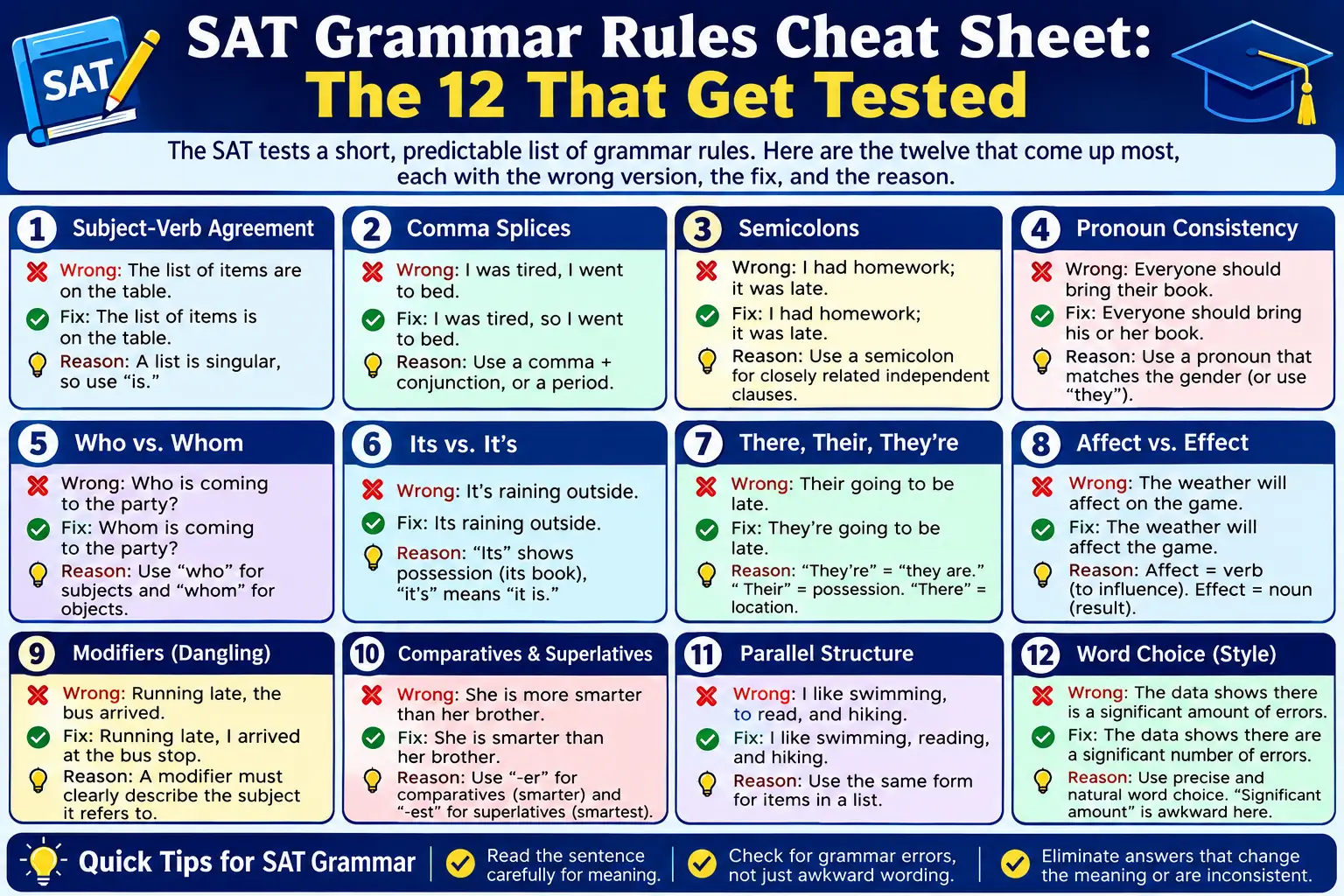
Here is the thing nobody tells you early enough: the SAT does not test grammar in general. It tests about a dozen rules, over and over.
Once you know which twelve, the writing section stops being about instinct and becomes about recognition. Below is each rule, an example of how it appears, and the fix.
1. Subject and verb must agree
The trap is rarely a simple sentence. It is a sentence with words stuffed between the subject and the verb.
- Wrong: The box of old letters are on the shelf.
- Right: The box of old letters is on the shelf.
The move: cover everything between the subject and the verb with your finger. “The box is on the shelf.” One box.
2. Pronouns must agree with what they replace
- Wrong: Each student must bring their own calculator.
- Right: Each student must bring his or her own calculator.
“Each” is singular. The SAT treats each, every, either, neither, someone, everyone and nobody as singular every time.
3. Modifiers must sit next to what they modify
- Wrong: Running late, the bus was missed by Sara.
- Right: Running late, Sara missed the bus.
The bus was not running late. Whatever follows the opening phrase must be the thing doing the action.
4. Items in a list must match in form
- Wrong: She likes swimming, hiking and to ride her bike.
- Right: She likes swimming, hiking and riding her bike.
The move: read each item after the verb separately. If one sounds different, it is the wrong shape.
5. Comparisons must compare the same kind of thing
- Wrong: The population of Texas is larger than California.
- Right: The population of Texas is larger than that of California.
A population can only be compared to a population, not to a state.
6. Commas around information you could delete
If a phrase can be removed without changing which thing you mean, it takes commas on both sides.
- My brother**, who lives in Boston,** is visiting. (I have one brother.)
- My brother who lives in Boston is visiting. (I have several; this is the Boston one.)
The move: delete the phrase. If the sentence still identifies the right thing, use commas.
7. Semicolons join two complete sentences
- Wrong: The test was hard**;** although I passed.
- Right: The test was hard**;** I passed anyway.
The move: cover the semicolon. Both sides must stand alone as sentences. If either cannot, you need a comma or a full stop.
8. Apostrophes: possession, never plurals
- Wrong: The student’s arrived early.
- Right: The students arrived early.
- Right: The student’s essay was late. (one student)
- Right: The students’ essays were late. (several students)
And it never takes an apostrophe when it shows ownership. It’s always means “it is”.
9. Verb tense stays consistent
- Wrong: She walked into the room and sits down.
- Right: She walked into the room and sat down.
Tense only changes when the time genuinely changes.
10. Word pairs must be completed correctly
Some pairs are fixed, and the SAT knows you may half-remember them.
| Start | Must finish with |
|---|---|
| not only | but also |
| either | or |
| neither | nor |
| both | and |
| between | and |
11. Shorter is correct
When two answers are both grammatical, the SAT wants the shorter one. Repeated ideas are treated as errors.
- Wrong: The annual meeting happens every year.
- Right: The annual meeting is on Tuesday.
The move: if two words in a sentence mean the same thing, one of them is the answer to delete.
12. Transitions must match the logic
- Wrong: It rained all day. Therefore, we still went out.
- Right: It rained all day. Even so, we still went out.
The move: decide whether the second sentence agrees with the first, contradicts it, or results from it. Then pick the transition that matches. However and therefore are not interchangeable.
The single most useful habit
Read the whole sentence, not the underlined part. The error is often created by something outside the underlined section, especially with subject-verb agreement and modifiers.
And when two answers both sound fine, choose the shorter one. That single rule resolves a surprising share of the questions.
Where to go next
- Twelve common English mistakes, which overlap heavily with this list
- Is vs are, the agreement rule in detail
- 11th grade vocabulary words for the reading section
- Practice questions with instant feedback
Questions people ask
How many grammar rules does the SAT actually test?
About twelve, tested repeatedly in different sentences. The list above covers the great majority of questions.
Do I need to know grammar terms like “subordinate clause” for the SAT?
No. The test never asks you to name anything. It only asks you to pick the correct version, so the tests in this article matter more than the terminology.
What is the most common SAT grammar error?
Subject-verb agreement with words placed between the subject and the verb, followed by comma use around non-essential information.
If two answers both sound right, what should I pick?
The shorter one, provided it keeps the meaning. The SAT consistently rewards concision.
For the official description of what the writing section assesses, see the College Board’s SAT suite information.