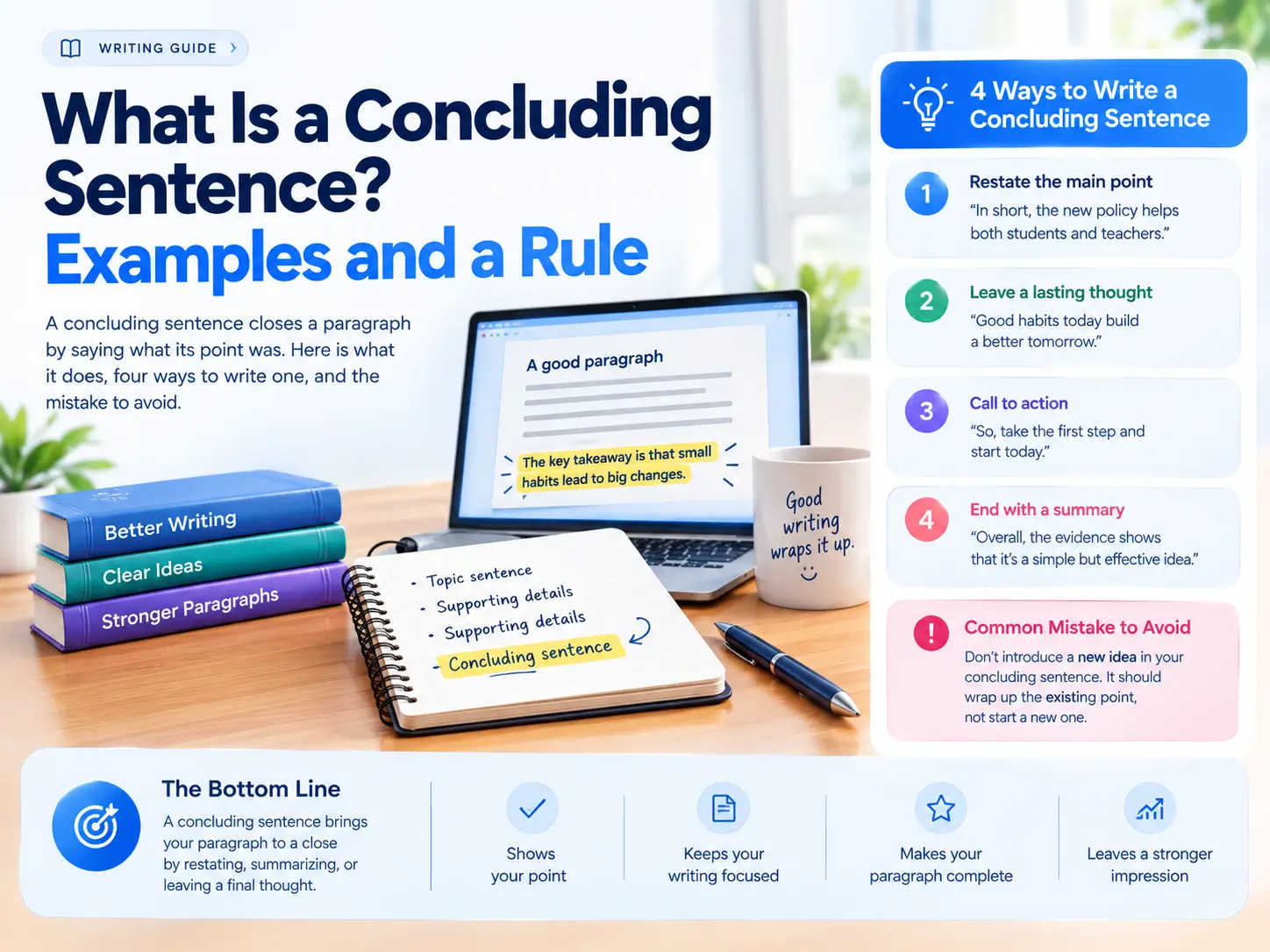
A concluding sentence is the last sentence of a paragraph. Its job is to say what the paragraph proved, in your own words, so the reader is left with the point rather than the last detail.
Every paragraph has three parts:
- Topic sentence. What this paragraph is about.
- Body. Evidence, examples, explanation.
- Concluding sentence. What that evidence showed.
The concluding sentence is the one most students skip, and it is the one that makes a paragraph feel finished.
What it looks like
Here is a paragraph without one:
School should start later. Teenagers naturally fall asleep around 11pm because of how their body clocks change during puberty. A study of 9,000 students found that later start times improved attendance. Schools in Seattle that moved their start time saw grades rise.
That ends on a detail. The reader is left holding a fact about Seattle, not the argument.
Now with a concluding sentence:
School should start later. Teenagers naturally fall asleep around 11pm because of how their body clocks change during puberty. A study of 9,000 students found that later start times improved attendance. Schools in Seattle that moved their start time saw grades rise. The evidence points one way: a later bell would help students learn.
Same facts. The reader now leaves with the point.
Four ways to write one
1. Restate the point in different words
So the real problem is not laziness, it is biology.
Different words from the topic sentence. Never a copy of it.
2. Say what the evidence showed
Together, these studies show that start times affect grades as much as teaching does.
Best when the paragraph was mostly evidence.
3. Draw the consequence
If that is true, every school timetable in the country is built on the wrong assumption.
Strongest option in persuasive writing.
4. Link forward to the next paragraph
Sleep is only half the story, though.
Useful in longer essays. Use it sparingly, or the writing starts to feel like a chain of promises.
The mistake almost everyone makes
Do not repeat the topic sentence.
- Topic sentence: School should start later.
- Weak conclusion: In conclusion, school should start later.
That teaches the reader nothing and wastes a sentence. A marker sees it immediately.
The test: cover the topic sentence and read only your concluding sentence. If it adds nothing the topic sentence did not already say, rewrite it.
Sentence starters that work
Use one, and not in every paragraph.
Restating: So, Clearly, The point is that, What this means is Showing evidence: These examples show, Together, this suggests, The pattern is clear Drawing a consequence: As a result, This is why, It follows that Linking forward: But that is only part of it, There is a second reason
Avoid In conclusion inside a paragraph. Save it for the end of the whole piece, and use it once.
Concluding sentence vs conclusion paragraph
These get confused, and they are different sizes of the same idea.
| Concluding sentence | Conclusion paragraph | |
|---|---|---|
| Length | One sentence | Three to five sentences |
| Closes | One paragraph | The whole essay |
| Job | Says what this paragraph showed | Says what the whole argument showed |
| How many | One per body paragraph | One per essay |
Does every paragraph need one?
In school essays, yes. Marking rubrics usually look for it directly.
In real-world writing, no. Short paragraphs in an email or an article often end on their strongest fact, and adding a summary would slow it down. Learn the rule first; break it later, on purpose.
Try it
Write a concluding sentence for this paragraph:
Dogs are good for your health. Owners walk an average of 22 minutes more a day than non-owners. Studies find lower blood pressure among people who live with a dog. One survey linked dog ownership with a lower risk of heart disease.
A workable answer: Taken together, a dog looks less like a pet and more like a prescription. Notice that it does not repeat “dogs are good for your health”.
Where to go next
- How to write clearly in English, including the so-what test
- Opinion writing sentence starters, sorted by the job each does
- Writing exercises for adults
- Check a paragraph for clarity and sentence length
Questions people ask
What is a concluding sentence in a paragraph?
The last sentence, which states what the paragraph showed so the reader ends with the point rather than the final detail.
How do you start a concluding sentence?
With a phrase that signals a summary, such as “So”, “These examples show” or “As a result”. Avoid “In conclusion” inside a paragraph.
Can a concluding sentence be a question?
Yes, in persuasive writing, if the question follows from the evidence. Used too often, it feels like a trick.
What is the difference between a concluding sentence and a conclusion?
A concluding sentence closes one paragraph. A conclusion is a whole paragraph that closes the entire piece.
Authority link: For how paragraph structure is described in professional writing standards, see the federal plain language guidelines.