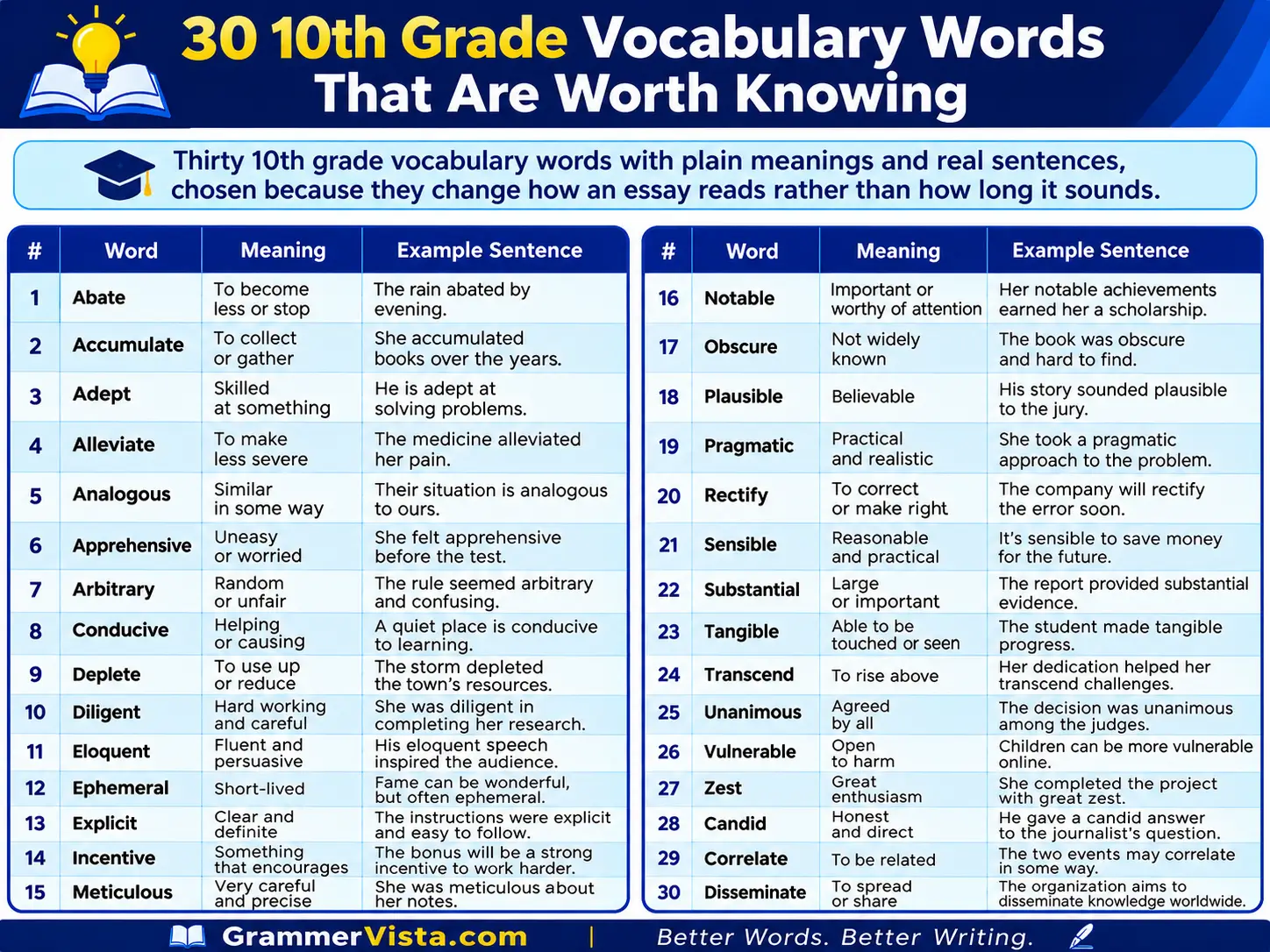
10th grade vocabulary is where shades of meaning start to matter. The difference between candid and blunt, or between prudent and timid, is the difference between a fair description and an insult.
These thirty words come up constantly in 10th grade texts and essays.
10th Grade Vocabulary Words List
| Word | What it means | Used in a sentence |
|---|---|---|
| adversity | serious difficulty or hardship | She kept studying despite real adversity at home. |
| alleviate | to make something less bad | Talking to a teacher alleviated his stress. |
| ambivalent | having mixed feelings about something | I am ambivalent about moving schools. |
| apathy | not caring at all | Voter apathy meant a low turnout. |
| arbitrary | decided with no real reason | The seating plan felt arbitrary. |
| candid | honest, even when it is uncomfortable | She gave a candid answer about her mistake. |
| cognitive | to do with thinking and understanding | Sleep affects cognitive performance. |
| complacent | too satisfied to keep trying | One good grade made him complacent. |
| conform | to behave the way a group expects | Not everyone wants to conform. |
| conspicuous | very easy to notice | His absence was conspicuous. |
| deference | respect that makes you give way | She spoke with deference to the older members. |
| deplore | to strongly disapprove of | The letter deplored the decision. |
| digress | to wander off the point | Sorry, I digress, back to the argument. |
| discern | to notice something hard to see | I could discern a pattern in the results. |
| disparity | a big and unfair difference | There is a disparity between the two schools. |
| dogmatic | insisting you are right and refusing to listen | His dogmatic tone ended the discussion. |
| eclectic | drawn from many different sources | She has eclectic taste in music. |
| empirical | based on observation, not theory | We need empirical evidence, not opinion. |
| exacerbate | to make a bad situation worse | Shouting only exacerbated the argument. |
| extol | to praise highly | The review extolled the film. |
| futile | pointless, with no chance of working | Arguing with him was futile. |
| hierarchy | a system of ranks | The report describes a strict hierarchy. |
| implicit | suggested but not stated outright | There was an implicit criticism in her reply. |
| inherent | built in, part of the thing itself | There is an inherent risk in the plan. |
| meticulous | extremely careful about detail | His notes are meticulous. |
| nuance | a small but important difference | The translation lost the nuance. |
| obsolete | no longer used because something better exists | Fax machines are obsolete. |
| pragmatic | practical rather than idealistic | She took a pragmatic approach. |
| prudent | sensible and careful about the future | It is prudent to save some of it. |
| superficial | only on the surface, not deep | His knowledge of the topic was superficial. |
Pairs that are not the same
This is where 10th grade vocabulary gets genuinely useful. These words are often treated as swappable, and they are not.
- Candid vs blunt. Candid means honest. Blunt means honest without care for feelings. Calling someone candid is a compliment. Calling them blunt usually is not.
- Prudent vs timid. Prudent means you thought about the risk. Timid means you were afraid of it. One is judgement, the other is fear.
- Ambivalent vs indifferent. Ambivalent means you have strong feelings on both sides. Indifferent means you have no feelings at all. They are close to opposites, and this pair is mixed up constantly.
- Implicit vs explicit. Implicit is suggested. Explicit is stated outright. If a text “implies” it, it is implicit.
- Empirical vs anecdotal. Empirical means measured and observed. Anecdotal means one person’s story. This distinction wins marks in science and history essays.
Using them without sounding forced
There is a trap here. A 10th grader who has just learned ubiquitous will use it four times in one essay, and it reads badly.
The test is simple: does the longer word say something the short word could not?
- “The risk is inherent in the design” says something “the design is risky” does not. It says the risk cannot be removed without changing the design. Keep it.
- “He was ambivalent” beats “he had mixed feelings” only slightly, and only if the rest of the sentence is short. Judgement call.
- “Utilise the pen” says nothing; “use the pen” does not. Cut it.
Precision earns marks. Length does not.
Where to go next
- 9th grade vocabulary words if you want to check the earlier list first
- 11th grade vocabulary words for the next step up
- How to write clearly, including when a shorter word beats a longer one
- Look up any word for meaning, synonyms, and opposites
Questions people ask
How is 10th grade vocabulary different from 9th grade?
Ninth grade is mostly about learning new words. Tenth grade is about telling similar words apart, such as candid from blunt, or prudent from timid.
Should I use long words to get better grades?
No. Use precise words. A long word used loosely loses more marks than a short word used exactly.
How long does it take to learn thirty words properly?
About three weeks at ten minutes a day, if you space the reviews out and write each word in your own sentence.
For how word meanings are grouped and distinguished, see the overview of vocabulary on Wikipedia.