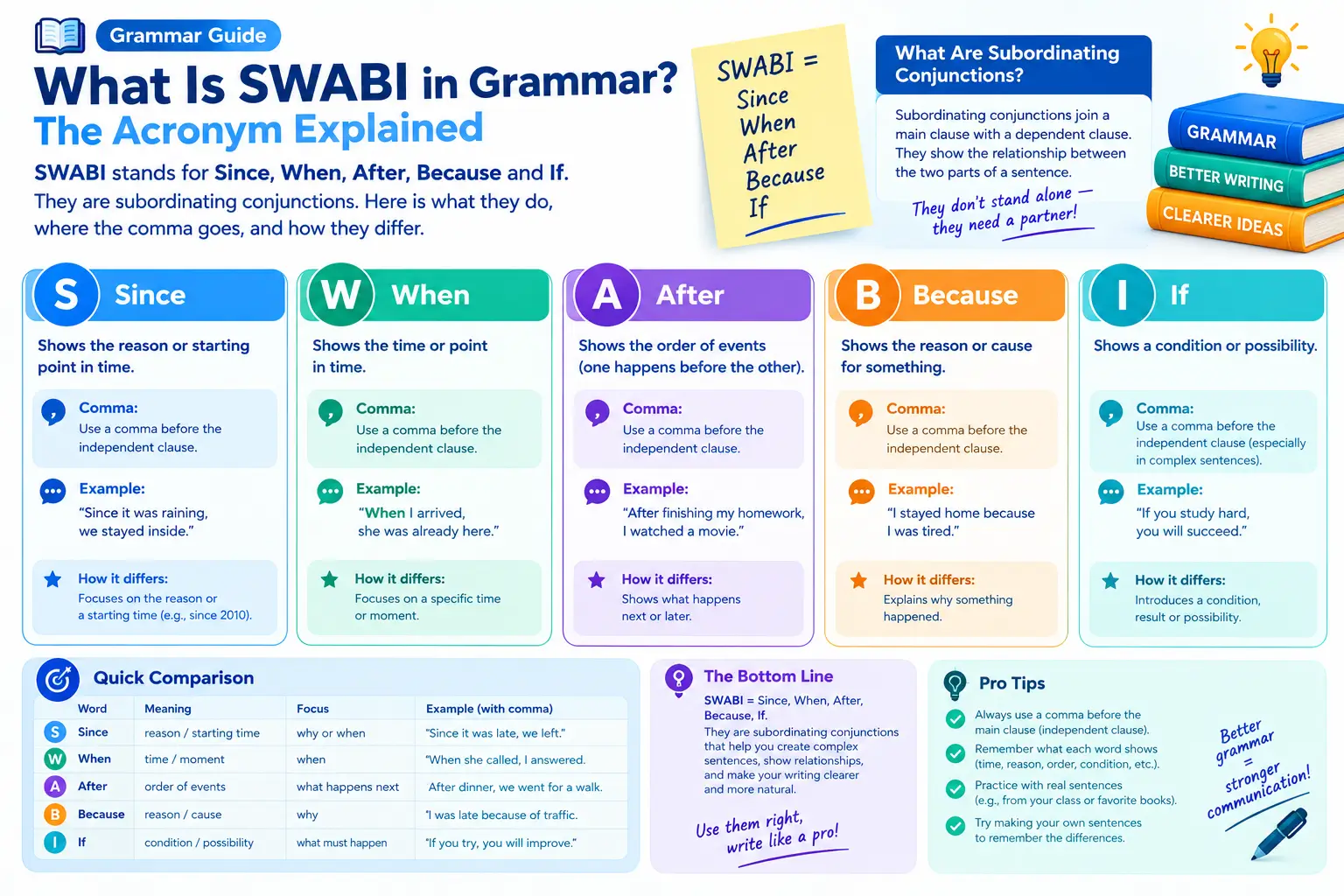
SWABI stands for Since, When, After, Because, and If. They are subordinating conjunctions, which are words that attach a weaker half of a sentence to a stronger half.
That is the whole answer. Now here is what it actually means, in plain words.
First, the two halves of a sentence
To use SWABI, you need one idea. Just one.
Some groups of words can stand alone as a sentence:
I ate lunch.
That is a complete thought. It works on its own.
Other groups of words cannot:
Because I was hungry.
Something is missing. Your brain waits for the rest. That is a dependent clause, and every SWABI word creates one.
A SWABI word turns a complete thought into an incomplete one. That is its entire job.
- I was hungry. (complete)
- Because I was hungry. (now incomplete)
Then you attach it to a complete thought and the sentence works again:
Because I was hungry, I ate lunch.
The five words
| Letter | Word | Example |
|---|---|---|
| S | Since | Since it was raining, we stayed inside. |
| W | When | When the bell rang, everyone stood up. |
| A | After | After she finished, she went home. |
| B | Because | Because the road was closed, we were late. |
| I | If | If you study, you will pass. |
The comma rule, which is the real reason SWABI is taught
Teachers do not teach this acronym so students can name conjunctions. They teach it so students put the comma in the right place.
There are only two situations.
When the SWABI half comes first, use a comma.
Because I was hungry, I ate lunch. After the film ended, we walked home.
When the SWABI half comes second, use no comma.
I ate lunch because I was hungry. We walked home after the film ended.
That is the whole rule. The front half takes a comma; the back half does not.
The test: find the SWABI word. If it is the first word of the sentence, there is a comma coming before the second half.
Why the acronym is only five words
There are far more subordinating conjunctions than five. Although, while, unless, until, before, whenever, even though, and so that all do the same job.
SWABI is a memory aid, not a complete list. Five is what fits in a word you can say.
Some teachers use a longer version where the letters stand for slightly different words, such as So instead of Since, or Although instead of After. If your teacher’s version differs from this one, use theirs. The comma rule is identical either way.
SWABI, FANBOYS and THAMO
These three acronyms are usually taught together, and they are constantly mixed up. Each covers a different kind of joining word, and each takes different punctuation.
| Acronym | Stands for | What it joins | Punctuation |
|---|---|---|---|
| FANBOYS | For, And, Nor, But, Or, Yet, So | Two equal complete thoughts | Comma before it |
| SWABI | Since, When, After, Because, If | A weaker half to a stronger half | Comma only when the SWABI half is first |
| THAMO | Therefore, However, Also, Moreover, Otherwise | Two complete thoughts, showing a relationship | Semicolon before, comma after |
Compare the same idea three ways:
- FANBOYS: I was tired**, so** I went to bed.
- SWABI: Because I was tired, I went to bed.
- THAMO: I was tired**; therefore,** I went to bed.
All three are correct. They differ in formality and rhythm, not in meaning. THAMO is the most formal and the least natural in speech.
The mistake this acronym prevents
The reason these are drilled in school is the comma splice, where two complete sentences are joined with only a comma.
- Wrong: I was hungry, I ate lunch.
- Right, using SWABI: Because I was hungry, I ate lunch.
- Right, using FANBOYS: I was hungry, so I ate lunch.
- Right, using THAMO: I was hungry**; therefore,** I ate lunch.
The three acronyms are three tools for fixing the same error.
Practise it
Read each sentence and decide whether a comma is needed.
- If it rains ___ we will cancel the picnic.
- We will cancel the picnic ___ if it rains.
- After the game ended ___ the crowd left slowly.
Answers: 1 needs a comma because the SWABI half is first. 2 needs none because the SWABI half is second. 3 needs a comma, same reason as 1.
Where to go next
- English grammar in plain English, including clauses and sentence structure
- Grammar conventions, where punctuation rules fit in
- SAT grammar rules cheat sheet, where comma placement is rule six
- Check a sentence for comma and structure problems
Questions people ask
What does SWABI stand for in grammar?
Since, When, After, Because and If. They are the five subordinating conjunctions most commonly taught as a group.
Is SWABI the same as FANBOYS?
No. FANBOYS are coordinating conjunctions and join two equal complete thoughts, taking a comma before them. SWABIs join a weaker half to a stronger half, and only take a comma when the SWABI half comes first.
Do you always put a comma after a SWABI clause?
Only when the SWABI clause starts the sentence. If it comes second, no comma.
Are there only five SWABI words?
No. Many more subordinating conjunctions exist, including although, while, unless, until and before. SWABI is a memory aid, not a full list.
For a formal description of this word class, see the overview of English subordinators on Wikipedia.