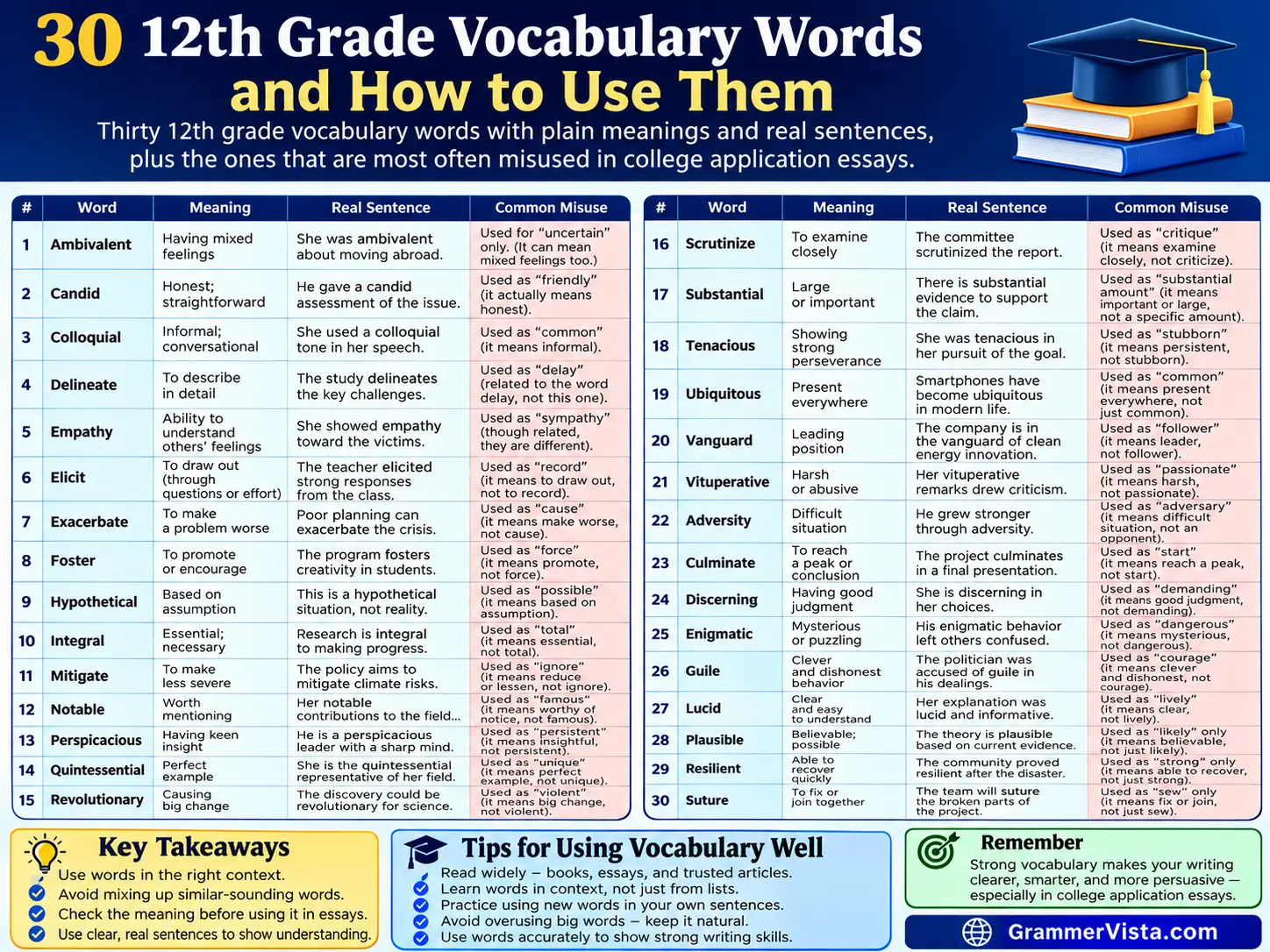
By 12th grade, the point is no longer collecting words. It is choosing them. These thirty are the ones that carry a precise judgement, which is what university-level writing is built from.
12th Grade Vocabulary Words List
| Word | What it means | Used in a sentence |
|---|---|---|
| anachronism | something in the wrong time period | A clock in a Roman play is an anachronism. |
| antithesis | the exact opposite | His calm was the antithesis of her panic. |
| apocryphal | widely repeated but probably untrue | The story is almost certainly apocryphal. |
| bellicose | eager to fight | The speech had a bellicose tone. |
| cacophony | a harsh, ugly mix of sounds | A cacophony of car horns. |
| capricious | changing suddenly for no reason | The weather was capricious all week. |
| deleterious | causing harm, usually slowly | Poor sleep has a deleterious effect on memory. |
| demagogue | a leader who wins support by stirring fear | The article calls him a demagogue. |
| didactic | intended to teach, often too obviously | The novel is didactic and heavy-handed. |
| ebullient | bubbling with enthusiasm | She was ebullient after the result. |
| effrontery | shameless boldness | He had the effrontery to ask for more. |
| enervate | to drain someone’s energy | The heat enervated the whole team. |
| esoteric | understood only by a small group | The paper is too esoteric for a general reader. |
| fatuous | silly and self-satisfied | A fatuous grin. |
| grandiloquent | using pompous, showy language | His grandiloquent speech impressed nobody. |
| hegemony | dominance of one group over others | The essay examines cultural hegemony. |
| ignominious | shameful and humiliating | An ignominious defeat. |
| immutable | impossible to change | The laws of physics are immutable. |
| inexorable | impossible to stop | The inexorable rise of the sea level. |
| intransigent | refusing to compromise at all | Both sides remained intransigent. |
| juxtapose | to place two things side by side to compare | The poem juxtaposes youth and age. |
| lugubrious | sad in a heavy, exaggerated way | A lugubrious expression. |
| mendacious | dishonest, in the habit of lying | The account was mendacious. |
| obdurate | stubbornly refusing to change | He was obdurate despite the evidence. |
| perfunctory | done without care, just to finish it | A perfunctory apology. |
| pusillanimous | cowardly | A pusillanimous retreat from the argument. |
| recalcitrant | resisting authority | A recalcitrant student. |
| sanguine | cheerfully optimistic | She is sanguine about her chances. |
| truculent | aggressively defiant | His truculent reply ended the meeting. |
| vicissitude | an unpredictable change of fortune | The vicissitudes of the campaign. |
The words that do real analytical work
Four of these are worth more than the rest, because they let you name something a reader can see but cannot label.
- Juxtapose. The single most useful word in literary analysis. It names the technique of putting two things next to each other so the contrast does the arguing.
- Antithesis. Both a plain opposite and a named rhetorical device. Knowing both meanings lets you analyse a speech properly.
- Didactic. The precise word for writing that teaches too openly. It says something “preachy” cannot say in an academic sentence.
- Anachronism. Essential for any historical text, and it is a genuine analytical observation rather than an opinion.
The trap in college application essays
Here is the honest warning. Every admissions reader has seen thousands of essays where a student reached for ebullient, sanguine, and grandiloquent in the first paragraph.
It does not read as intelligence. It reads as a thesaurus.
The test is whether the word is the one you would have chosen if you had never made a vocabulary list. If the sentence sounds like you, keep it. If it sounds like someone doing an impression of a scholar, cut it.
Ironically, grandiloquent is the word for exactly that failure, and using it to describe your own writing is the only safe way to use it.
Words that are almost always misused
- Sanguine does not mean calm. It means optimistic. The calm meaning belongs to phlegmatic.
- Fulsome does not mean generous. It means excessive to the point of being insincere. “Fulsome praise” is an insult.
- Enormity is not size. It is extreme wickedness or gravity.
- Peruse does not mean skim. It means to read carefully and thoroughly, which is the opposite of how most people use it.
- Nonplussed means confused, not unbothered, in standard British and formal use. American informal use has drifted the other way, so in an exam essay it is safest avoided entirely.
Where to go next
- 11th grade vocabulary words if you skipped the level below
- How to write clearly, including when the shorter word wins
- Build your English vocabulary, the method behind these lists
- Check a sentence and see stronger word suggestions
Questions people ask
Should I use these words in my college essay?
Only where one of them is genuinely the most precise word available. Admissions readers spot vocabulary that was inserted rather than chosen.
What is the hardest part of 12th grade vocabulary?
Not the meanings. It is the words that seem obvious and are not, such as sanguine, fulsome, enormity and peruse.
How do I stop forgetting words I have already learned?
Use them. A word you have written in your own sentence three times is yours. A word you have only read stays borrowed.
For how meaning shifts over time and why some of these words are commonly misused, see the overview of semantic change on Wikipedia.