Ninth grade is the year vocabulary stops being about long words and starts being about precise words. Texts get harder, essays get longer, and teachers start marking you down for saying “good” three times in a paragraph.
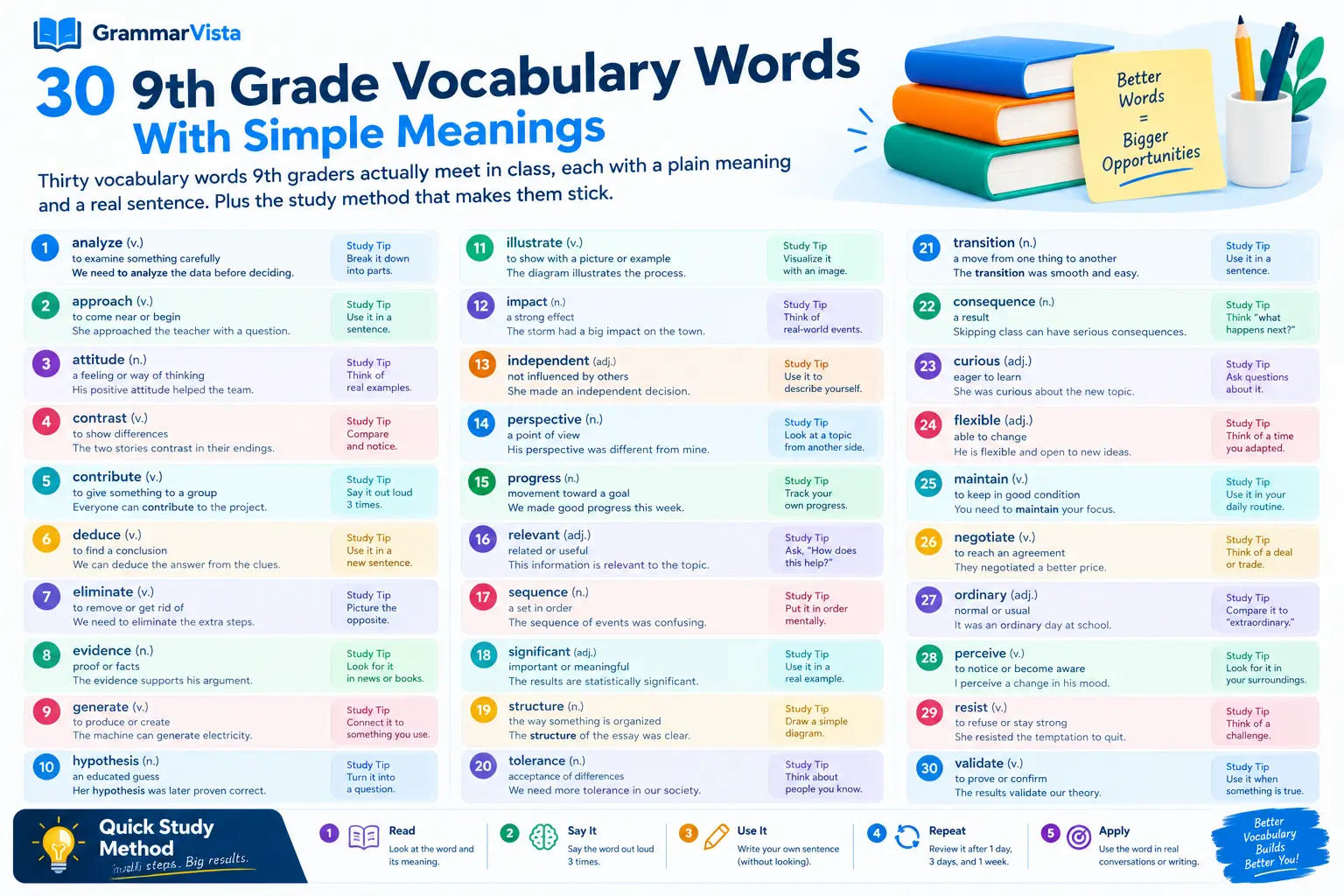
Below are thirty words that turn up again and again in 9th grade reading and writing. Each one has a plain meaning and a sentence you could actually say.
9th Grade Vocabulary list
| Word | What it means | Used in a sentence |
|---|---|---|
| abstract | about ideas, not things you can touch | Freedom is an abstract idea. |
| adhere | to stick to something, or to follow a rule | You must adhere to the school dress code. |
| ambiguous | able to mean two different things | Her answer was ambiguous, so nobody knew what she meant. |
| analogy | a comparison that explains something | He used an analogy comparing the brain to a computer. |
| anecdote | a short true story | She opened her speech with an anecdote about her grandmother. |
| articulate | to say something clearly | He could not articulate why he was upset. |
| benevolent | kind and generous | The benevolent stranger paid for our meal. |
| coherent | making sense, holding together | Your essay needs a coherent argument, not just facts. |
| compile | to gather things into one place | We compiled a list of every source we used. |
| concise | short and clear, with nothing wasted | Keep your answer concise. |
| condone | to accept wrong behaviour | The school does not condone cheating. |
| contradict | to say the opposite of something | His second statement contradicted his first. |
| credible | believable | The witness seemed credible. |
| deficient | not having enough of something | The report was deficient in evidence. |
| deteriorate | to get worse over time | Her handwriting deteriorated as she rushed. |
| diligent | working hard and carefully | She is a diligent student who checks everything twice. |
| discreet | careful not to attract attention | He was discreet about his friend’s secret. |
| elaborate | to add more detail | Could you elaborate on that point? |
| eloquent | speaking beautifully and persuasively | Her eloquent speech changed several minds. |
| empathy | understanding how someone else feels | Reading fiction builds empathy. |
| endorse | to publicly support | The newspaper endorsed the plan. |
| evasive | avoiding a direct answer | His evasive reply made everyone suspicious. |
| exemplify | to be a clear example of | This paragraph exemplifies good writing. |
| feasible | possible to do | Finishing in one night is not feasible. |
| frugal | careful with money | Her frugal habits helped her save. |
| hypothesis | an idea you are going to test | We hypothesized that plants grow faster in sunlight. |
| impartial | not taking sides | A judge must be impartial. |
| inevitable | certain to happen | With no revision, failure was inevitable. |
| integrity | being honest even when nobody is watching | He showed integrity by admitting the mistake. |
| substantiate | to back a claim with evidence | You need to substantiate that argument. |
The five that examiners look for
If you only take five into your next essay, take these. They are the ones that make an argument sound like it was thought about.
- Substantiate. Instead of “this proves”, write “this substantiates the claim that”. It signals that you know a claim needs evidence.
- Coherent. Useful for describing an argument, and useful for spotting when your own is not.
- Contradict. Essential the moment you compare two sources.
- Credible. The word for judging a source rather than just quoting it.
- Concise. Learn it, then obey it.
How to make them stick
Reading a list once does almost nothing. These four steps take about ten minutes a day and actually work.
- Learn words in sentences, not in columns. A word alone has no shape. A word in a sentence shows you what it sits next to, which is most of what “knowing a word” means.
- Use each new word in writing within 24 hours. Recognising a word and using a word are different skills. The second one is what gets marked.
- Space your reviews out. Look at a word today, again in three days, again in a week. Three separate sessions beat one long session, which is why cramming feels productive and then fails.
- Say the word out loud. You are far more likely to use a word in writing if you have heard yourself say it.
Test yourself
Cover the middle column and read only the sentences. If you can say what the word means from the sentence alone, you know it. If you cannot, that word goes on tomorrow’s list.
Then try the reverse: read the meaning and try to produce the word. That direction is harder, and it is the one that matters for writing.
Where to go next
- 10th grade vocabulary words, the natural next step
- Build your English vocabulary, the method behind the lists
- Look up any word for its meaning, synonyms, and opposites
- How to write clearly, where these words actually get used
Questions people ask
How many vocabulary words should a 9th grader learn a week?
Ten well is better than thirty badly. A word you can use is worth five you can only recognise.
What is the best way to learn vocabulary for a test?
Space the reviews out over several days and write each word in your own sentence. Rereading a list the night before produces recognition, which fades, rather than recall, which lasts.
Are these words on standardised tests?
Many overlap with the vocabulary tested on school and college entrance exams, because both draw from the same academic texts. Learn them for the reading, not for the test.
On why spaced review outperforms cramming, see the research summary on spaced repetition.