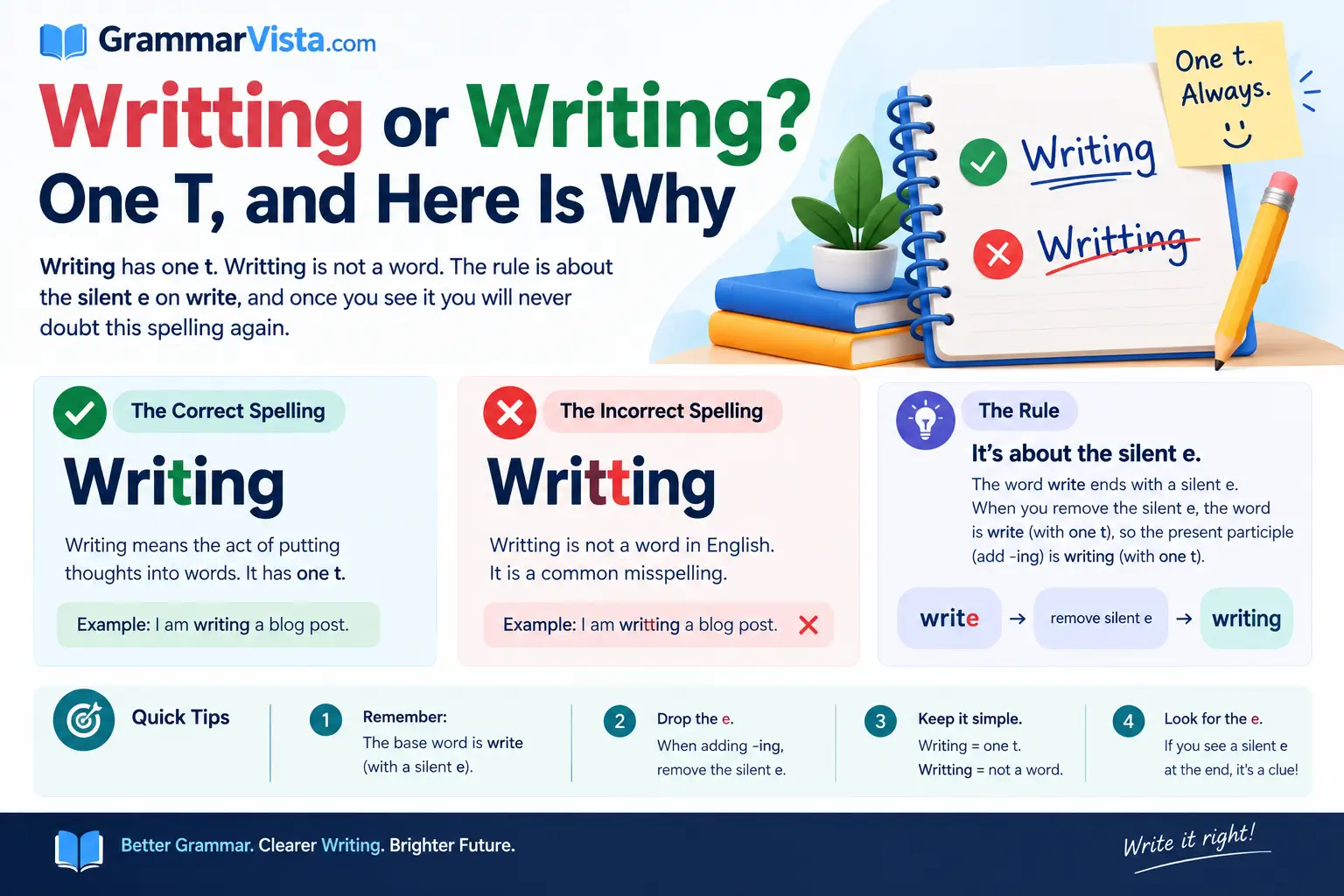
“Writing” is correct. “Writting” with two t’s is not an English word.
Same for the person: it is a writer, not a “writter”.
Why people double the t
English does double the final consonant before -ing in a lot of words, so the instinct is not silly. Look at these:
- sit → sitting
- run → running
- swim → swimming
- stop → stopping
So why not write → writting? Because those words follow a rule that “write” does not qualify for.
The rule, in one line
Double the final consonant only when the word ends in a single vowel followed by a single consonant, and the last syllable is stressed.
Check “sit”: s-i–t. One vowel, one consonant at the end. Stressed. So it doubles: sitting.
Now check “write”: w-r-i–t–e. It ends in e, not in a consonant. It does not qualify, so nothing doubles.
What actually happens to “write”
The e on the end is silent. Its job is to make the i say its own name, “eye”, rather than the short “ih” sound in sit.
When you add -ing, that silent e is no longer needed, so it drops:
write minus the e plus ing = writing
The same thing happens across the language:
| Base word | Add -ing |
|---|---|
| write | writing |
| make | making |
| take | taking |
| come | coming |
| hope | hoping |
| drive | driving |
| use | using |
Every one of them ends in a silent e, and every one of them drops it. None of them doubles a consonant.
Why the doubling matters at all
The doubled letter is a signal about the vowel sound, not decoration.
- hoping comes from hope, and the o says its own name
- hopping comes from hop, and the o is short
The double consonant tells your eye to keep the vowel short. If “writting” existed, it would rhyme with fitting, not with biting. The word you want has the long “eye” sound, so it takes one t.
That is the same pair of ideas in every case:
| One consonant, long vowel | Two consonants, short vowel |
|---|---|
| hoping | hopping |
| taping | tapping |
| striping | stripping |
| writing | (no such word) |
The test
Say the vowel out loud.
If the vowel says its own name, as in writing or hoping, use one consonant. If the vowel is short and clipped, as in sitting or hopping, use two.
“Writing” has the long “eye” sound. One t.
Related spellings people get wrong the same way
| Wrong | Right |
|---|---|
| writting | writing |
| writter | writer |
| writen | written |
| begining | beginning |
| refering | referring |
| commiting | committing |
The last three run the other way. Begin, refer and commit all end in a single vowel plus a single consonant with the stress on the last syllable, so they do double.
Note that written genuinely has two t’s. That is not an exception to the rule, it is a different word formed a different way, and it is the form that follows have, has or had: “I have written.”
What to read next
- Grammar vs grammer, the other spelling people ask about most
- Twelve common English mistakes, each with a memory test
- Check your own writing against a 276,734 word dictionary
Questions people ask
Is “writting” a word in any form of English?
No. It is not valid in American, British, Australian, or any other standard variety.
Why is it “written” with two t’s but “writing” with one?
They are formed differently. “Writing” is written with the silent e dropped. “Written” is an older irregular form that has always carried two t’s, and it is the form used after have, has, or had.
When should I double the last letter before -ing?
Only when the word ends in one vowel plus one consonant and the last syllable is stressed. Sit qualifies, so it becomes sitting. Write ends in e, so it does not.
Is it “writer” or “writter”? Writer, one t, for the same reason.
For the wider set of rules governing this pattern, see English orthography on Wikipedia.