Have you ever received a text message that says “dw, everything is fine” and wondered what the person meant? If so, you are not alone. Short forms and abbreviations are common in online conversations, especially when people want to send messages quickly.
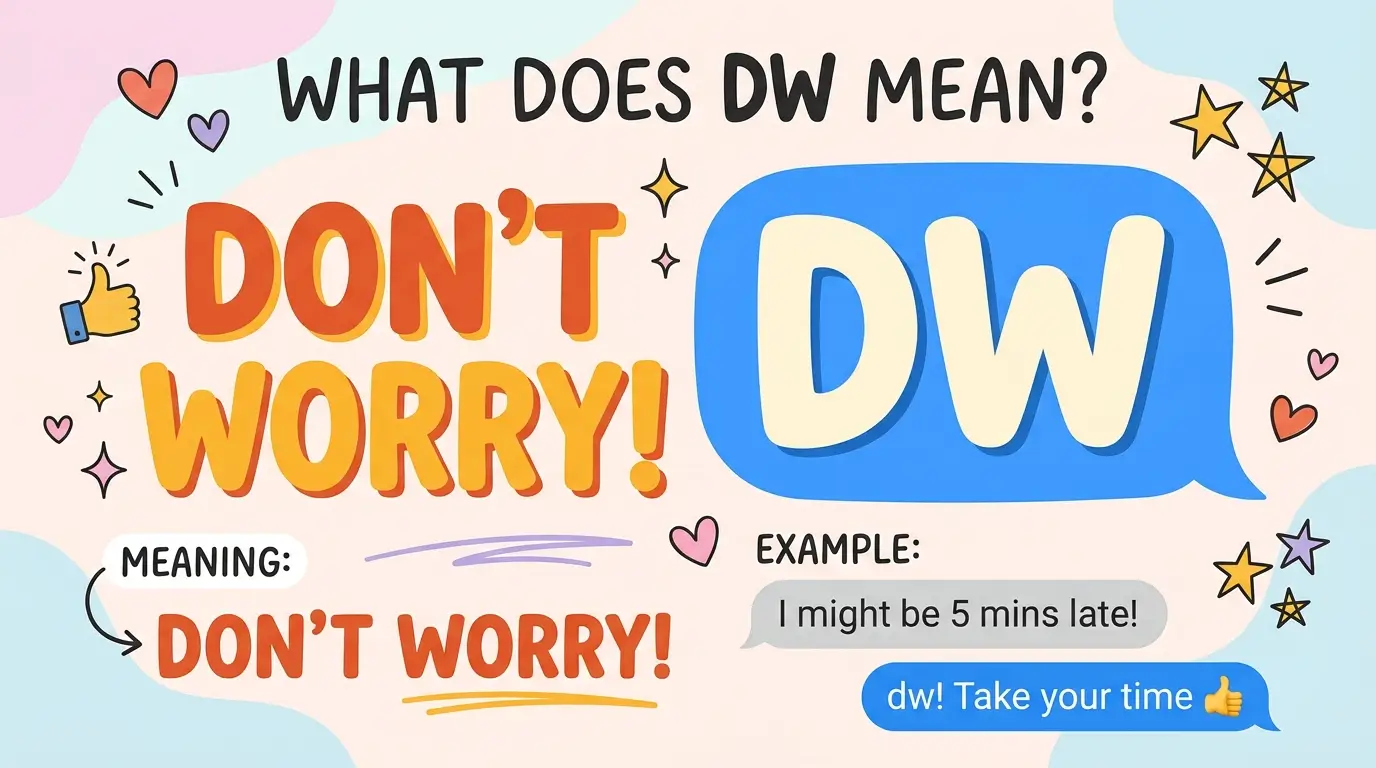
DW usually means “don’t worry” in text messages. People use it to reassure someone, reduce their concerns, or let them know that a situation is under control. For example, if a friend apologizes for replying late, you might respond with “dw, it’s okay.”
However, the meaning of DW can change depending on the conversation. In some situations, it may stand for something else, such as “dear wife” or “Doctor Who.” Understanding the context helps you figure out which meaning fits the message.
In this guide, you’ll learn what DW means in text, how people use it on social media, what it means in relationships, and how to respond when someone sends it to you.
What Does DW Mean in Text?
In texting and online conversations, DW stands for “don’t worry.” It is a casual abbreviation used to reassure another person that they do not need to feel stressed, guilty, or concerned about something.
People commonly use DW in text messages, direct messages, group chats, gaming conversations, and social media comments.
Here are a few simple examples:
- “DW, I’ll handle it.”
- “Dw about the homework, we can finish it tomorrow.”
- “DW, you’re not bothering me.”
- “It’s okay, dw!”
- “DW, everything is going to be fine.”
In each example, DW communicates reassurance. It tells the other person that the situation is not as serious as they might think.
What Does DW Stand for?
DW is an abbreviation formed from the first letters of “don’t” and “worry.” It saves time and makes messages shorter.
For example:
Full sentence: Don’t worry, I’ll call you later.
Text message: DW, I’ll call you later.
Both messages communicate the same basic idea, but the second is shorter and more casual.
The abbreviation is especially common in informal conversations where people already understand each other’s texting habits.
Is DW the Same as Don’t Worry?
Yes, when DW is used in its most common texting sense, it means “don’t worry.”
However, the tone can vary depending on the person and situation. Someone might use DW to comfort you sincerely, while another person might use it simply to end a conversation about a small problem.
For example:
- “DW, I know you didn’t mean it.” This sounds reassuring.
- “DW about it, it’s not important.” This may suggest that the issue is minor.
- “Dw lol, you’re fine.” This sounds relaxed and friendly.
The abbreviation itself does not reveal every emotion behind the message. The surrounding words and your relationship with the sender provide additional clues.
What Does DW Mean in Texting and Chat?
DW is widely suited to informal digital communication because it conveys a familiar phrase in just two letters.
People use it in several everyday situations.
1. When Someone Apologizes
If a friend makes a mistake or apologizes for something small, DW can show that you are not upset.
Example:
Friend: “Sorry, I forgot to send you the picture.”
You: “Dw, you can send it later.”
Here, DW means that the mistake is not a problem.
2. When Someone Is Worried
DW is often used when another person is anxious about an upcoming event or an uncertain situation.
Example:
Friend: “I’m nervous about tomorrow’s presentation.”
You: “DW, you’ve prepared well. You’ll do great.”
In this conversation, DW is a way to offer encouragement and help someone feel more comfortable.
3. When Making Plans
People may use DW when plans change or someone is concerned about being late.
Example:
Person A: “I’m running ten minutes late. Sorry!”
Person B: “Dw, I’ll wait for you.”
The message communicates patience and shows that the delay is acceptable.
4. When Offering Help
DW can also be used to reassure someone that they do not need to handle a problem alone.
Example:
Friend: “I don’t know how I’m going to finish all this work.”
You: “Dw, we can work on it together.”
Here, the abbreviation introduces a supportive message.
5. In Group Chats
In group conversations, DW can quickly settle a minor concern without requiring a long explanation.
For example:
“Dw guys, I saved a copy of the file.”
This tells everyone that the file is safe and there is no need to panic.
What Does DW Mean From a Girl?
When a girl sends you DW, it usually means “don’t worry.” The exact meaning depends on your relationship, the topic, and the tone of the conversation.
She might use it to reassure you, show that she is not upset, or make a conversation feel more relaxed.
For example:
You: “Sorry if I bothered you with too many messages.”
Her: “Dw, you’re fine.”
In this case, she is likely telling you that you have not bothered her.
Another example:
You: “Sorry I couldn’t reply earlier.”
Her: “Dw, I was busy too.”
This is a casual way of saying that she understands and is not concerned about the delay.
Does DW Mean She Likes You?
Not necessarily. DW alone is not a reliable sign of romantic interest.
It can reflect friendliness, kindness, politeness, or simple reassurance. If you want to understand whether someone may be interested in you, pay attention to the broader pattern of communication rather than one abbreviation.
Consider whether she:
- Starts conversations with you.
- Shows interest in your life.
- Makes an effort to spend time with you.
- Responds warmly and consistently.
- Communicates interest beyond ordinary friendly messages.
Even these behaviors are not definitive proof of romantic feelings. The best way to understand someone’s intentions is through honest, respectful communication.
What Does DW Mean From a Boy?
When a boy sends DW, it generally has the same meaning: “don’t worry.”
He might use it to reassure you that he is not upset, tell you that a mistake is unimportant, or show that he understands your situation.
For example:
You: “Sorry, I forgot to tell you about the meeting.”
Him: “Dw, it’s all good.”
This suggests that he is not concerned about the mistake.
Another example:
You: “Are you angry with me?”
Him: “No dw.”
In this case, he is directly reassuring you that you do not need to worry about his feelings.
Does DW Mean He Cares About You?
It can be a friendly or caring response, but it does not automatically mean romantic interest.
Someone may use DW because they want to make another person feel comfortable. That can be a sign of kindness, but the abbreviation itself does not establish deeper feelings.
Look at the full conversation and how the person generally treats you instead of interpreting two letters as a definite signal.
What Does DW Mean in a Relationship?
In a relationship, DW commonly means “don’t worry,” and it can be used to provide reassurance during everyday conversations.
Partners may use it when one person feels guilty, becomes anxious, or worries that something has gone wrong.
Here are some examples.
Example 1: Reassuring a partner
Partner A: “Sorry I couldn’t call you earlier.”
Partner B: “Dw, I understand.”
This communicates understanding and acceptance.
Example 2: Clearing up a misunderstanding
Partner A: “I thought you were upset with me.”
Partner B: “Dw, I’m not angry.”
The message helps clarify the situation.
Example 3: Discussing plans
Partner A: “I’m worried we won’t have enough time to get everything ready.”
Partner B: “Dw, we’ll figure it out.”
This expresses support and confidence.
Can DW Sound Cold in a Relationship?
Sometimes, yes. A very short response can feel dismissive if the other person is discussing something serious.
For example, if someone explains a genuine concern and receives only “dw,” they might feel that their feelings have been brushed aside.
The meaning depends on the situation. In a casual conversation, DW may be perfectly appropriate. During an emotional discussion, a fuller response may communicate more care.
Instead of saying only “dw,” someone could write:
“Don’t worry, I’m here for you. Let’s talk about it.”
The additional words provide reassurance without leaving the other person guessing.
Other Meanings of DW
Although “don’t worry” is the most common meaning in everyday texting, DW can stand for other things in specific contexts.
Understanding these alternatives helps prevent confusion.
1. DW Means Dear Wife
In some online discussions, particularly in older internet forums and family-related conversations, DW can mean “dear wife.”
This abbreviation is sometimes used alongside:
- DH: Dear husband.
- DS: Dear son.
- DD: Dear daughter.
For example:
“My DW and I are planning a vacation.”
Here, DW refers to the writer’s wife, not the phrase “don’t worry.”
These family-related abbreviations are often associated with parenting communities and discussion forums.
2. DW Means Doctor Who
DW may refer to Doctor Who, the long-running British science-fiction television series.
For example:
“I’m watching DW tonight.”
If the conversation is about television shows, science fiction, or favorite characters, DW may refer to the series.
Context makes the intended meaning easier to identify.
3. DW as a Name or Initialism
DW can also be part of a company name, username, product name, or technical abbreviation.
For instance, someone discussing a particular business might use DW as its initials. In technical or professional settings, the letters may have a specialized meaning.
There is no single interpretation that applies to every situation.
4. DW in Gaming Communities
In gaming conversations, DW may have a meaning specific to the game, team, or community.
Sometimes it still means “don’t worry,” especially when players reassure teammates after a mistake.
For example:
“Dw, we can win the next round.”
However, if the conversation concerns a specific game mechanic, character, or team name, check the surrounding discussion before deciding what DW means.
How Can You Tell Which Meaning Is Correct?
Use these simple clues:
- Everyday texting: DW probably means “don’t worry.”
- Marriage or family discussions: It may mean “dear wife.”
- Television conversations: It may refer to Doctor Who.
- Work or technical discussions: It may be a specialized abbreviation.
- Gaming chats: The meaning depends on the conversation and game.
If you are still unsure, asking the sender is usually the easiest solution.
What Is the Difference Between DW, DW About It, and Don’t Worry?
These expressions are closely related, but they can be used slightly differently.
DW
DW is the short form of “don’t worry.”
Example: “Dw, I’ll help you.”
DW About It
This means that the person should not worry about a particular matter.
Example: “Dw about the mistake. We can fix it.”
Depending on the tone, it can also suggest that the subject does not need further discussion.
Don’t Worry
This is the complete phrase and is generally clearer in situations where the other person may not understand texting abbreviations.
Example: “Don’t worry, I have already taken care of everything.”
The full phrase can feel more personal or reassuring because it gives the message a little more detail.
DW vs. Other Common Text Abbreviations
DW is one of many abbreviations people use in digital conversations. Learning a few related terms can make online communication easier.
| Abbreviation | Meaning | Example |
|---|---|---|
| DW | Don’t worry | “Dw, it’s okay.” |
| NP | No problem | “NP, happy to help.” |
| NVM | Never mind | “Nvm, I found it.” |
| IDC | I don’t care | “Idc which movie we watch.” |
| IMO | In my opinion | “IMO, this is better.” |
| BRB | Be right back | “Brb, getting water.” |
| BTW | By the way | “BTW, are you coming?” |
| TBH | To be honest | “Tbh, I enjoyed it.” |
| LMK | Let me know | “LMK when you’re free.” |
| WDYT | What do you think? | “WDYT about this idea?” |
These abbreviations are generally used in informal conversations, although their popularity can vary across age groups, communities, and platforms.
Remember that an abbreviation’s meaning may change with context, so the surrounding message always matters.
How to Reply When Someone Texts DW
If someone sends you DW, your response depends on what they are trying to communicate and whether the conversation needs to continue.
Here are several natural replies.
1. When Someone Reassures You
If you were worried about something and the other person tells you not to worry, you can simply acknowledge their message.
Examples:
- “Okay, thank you!”
- “I appreciate it.”
- “Thanks for understanding.”
- “That’s good to know.”
- “Alright, I feel better now.”
2. When Someone Says They Are Not Upset
If you apologized and the other person replied with DW, you can respond casually.
Examples:
- “Thanks for understanding.”
- “Okay, glad we’re good.”
- “I appreciate that.”
- “Thanks, I’ll be more careful next time.”
You do not need to keep apologizing if the issue has already been resolved.
3. When You Want to Keep the Conversation Friendly
You can use a relaxed response if the conversation is casual.
Examples:
- “You’re the best!”
- “Haha, thanks.”
- “Alright, good!”
- “Thanks, that’s a relief.”
Choose a response that matches your normal communication style.
4. When You Are Unsure What DW Means
If the conversation does not make the meaning clear, ask a simple question.
For example:
“Hey, just checking, what do you mean by DW here?”
There is nothing wrong with asking for clarification. Abbreviations are not always understood in the same way by everyone.
Is DW Formal or Informal?
DW is an informal abbreviation. It is suitable for casual conversations with friends, family members, classmates, and people who are comfortable using text slang.
It is generally less suitable for formal emails, official letters, professional reports, and serious business communication.
For example:
Informal: “Dw, I’ll send the file tonight.”
Professional: “Please don’t worry. I’ll send the file this evening.”
The second version is clearer and more appropriate for most workplace situations.
The best choice depends on the relationship between the people communicating and the expectations of the conversation.
Is DW Rude?
No, DW is not inherently rude. In most casual conversations, it is intended to reassure someone.
However, any short message can sound dismissive depending on the situation.
For example, responding with “dw” to a friend who is worried about a minor delay may be perfectly normal. Using the same response when someone is sharing a serious personal problem might feel insensitive.
Consider the situation, the other person’s feelings, and the tone of the conversation.
If you want to sound more supportive, you can add a few words:
- “Dw, I’m here if you need me.”
- “Don’t worry, we’ll work it out.”
- “It’s okay. I understand.”
- “Dw, you can talk to me about it.”
These responses communicate reassurance more clearly than the abbreviation alone.
Why Do People Use DW Instead of Writing the Full Phrase?
People use abbreviations because they can make casual messages quicker and easier to type.
DW communicates a familiar phrase without requiring the sender to write every word. It also fits naturally into short conversations where both people understand common texting expressions.
There are several reasons people use it:
- Speed: Two letters are quicker to type than the full phrase.
- Convenience: Short messages are easy to send during everyday activities.
- Informal tone: DW can make a conversation feel relaxed and friendly.
- Shared understanding: People familiar with texting abbreviations can understand the intended meaning quickly.
However, shorter is not always better. If the situation is sensitive or the meaning might be unclear, writing the complete phrase can prevent misunderstandings.
There is no need to use abbreviations in every message. Clear communication matters more than saving a few characters.
Frequently Asked Questions About DW
What Does DW Mean in Text From a Girl?
DW usually means “don’t worry” when a girl sends it in a text. She may be reassuring you, accepting an apology, or telling you that something is not a problem. It does not automatically mean that she has romantic feelings.
What Does DW Mean in Text From a Guy?
When a guy sends DW, it generally means “don’t worry.” He may be trying to reassure you that he is not upset or that a situation is under control.
What Does DW Mean on Snapchat?
On Snapchat, DW usually means “don’t worry.” It can appear in chats, replies to stories, or messages between friends.
What Does DW Mean on Instagram?
On Instagram, DW generally means “don’t worry.” People may use it in direct messages, comments, and casual conversations.
What Does DW Mean on WhatsApp?
On WhatsApp, DW usually stands for “don’t worry.” For example, “Dw, I’ll call you later” means “Don’t worry, I’ll call you later.”
What Does DW Mean in a Relationship?
In a relationship, DW usually communicates reassurance. It may mean that a partner is not upset, understands a mistake, or wants the other person to feel less worried.
Does DW Mean Don’t Worry or Dear Wife?
Both meanings exist, but context determines which one is intended. In ordinary text messages, “don’t worry” is generally the more likely interpretation. In family discussions or online forums about marriage, DW may mean “dear wife.”
What Does DW Mean in a Message From Your Crush?
It usually means “don’t worry.” Your crush might be reassuring you after an apology or telling you that something is fine. The abbreviation alone cannot tell you whether the person is romantically interested.
Should I Use DW in Professional Messages?
It is usually better to write “don’t worry” in full when communicating in formal or professional settings. DW is more appropriate for casual chats where abbreviations are expected.
What Should I Do if I Don’t Understand DW?
Look at the context first. If the meaning remains unclear, ask the sender what they mean. A simple question is better than making an incorrect assumption.
Conclusion
So, what does DW mean in text? In most everyday digital conversations, DW means “don’t worry.” People use it to reassure others, accept apologies, reduce concerns, and keep conversations friendly.
You may encounter DW on Snapchat, Instagram, WhatsApp, gaming platforms, and other messaging services. Although it can also mean “dear wife,” refer to Doctor Who, or represent other terms in specific contexts, “don’t worry” is usually the intended meaning in casual texting.
The key is to consider the surrounding conversation rather than interpreting the abbreviation on its own. If a friend sends “dw, it’s okay,” they are most likely telling you that there is no need to worry.
Once you understand this simple abbreviation, recognizing it in everyday messages becomes much easier.