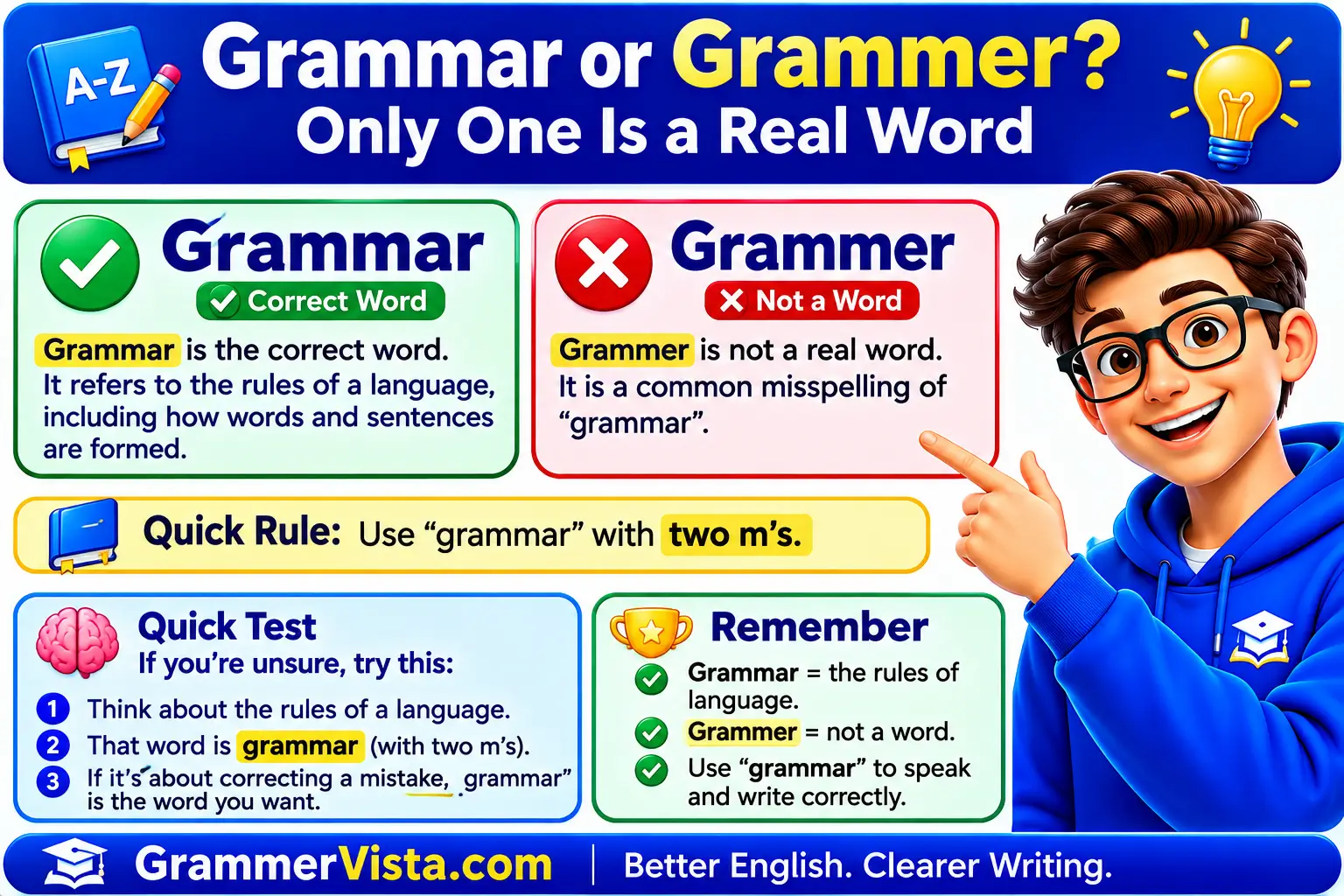
“Grammar” is the correct spelling. “Grammer” is not a word in English.
If you are writing quickly and stop to wonder which one it is, the answer is always grammar, with an a in the second syllable.
That is the whole answer. But the reason people get it wrong is genuinely interesting, and once you understand it, you stop making the mistake for good.
Why so many people write “grammer”
Say the word out loud. Gram-mer. The second syllable sounds exactly like the ending of farmer, teacher, writer, singer.
That sound is called a schwa. It is the lazy, unstressed vowel English uses in the middle and end of most words, and it sounds the same no matter which letter is written there. Your ear cannot tell an a from an e in that position, because there is nothing to hear.
So your brain does something reasonable: it reaches for the most common spelling of that sound. And in English, the most common way to end a word with that sound is -er.
- teach → teacher
- farm → farmer
- sing → singer
- write → writer
Hundreds of English words follow that pattern. “Grammar” does not, and there is no way to hear the difference. That is why this is one of the most common misspellings in English, and why it says nothing about how good your English is.
Why grammar ends in -ar
The word did not come from an English verb plus -er. It came into English from Old French gramaire, which came from Latin grammatica, which came from Greek grammatike, meaning the art of letters.
The a survived the whole journey. It was never an -er ending, because it was never “one who grammars”.
Compare a few relatives that kept the same vowel:
- grammar and grammatical
- calendar, from Latin calendarium
- particular, from Latin particularis
The memory trick
Here is the test that works in half a second:
Grammar has the same ending as gram-mat-i-cal.
Say “grammatical,” and you will hear the a clearly, because in that longer word the syllable is stressed. The vowel is loud and obvious. Then keep that same a when you shorten the word back to grammar.
That is the reliable move with any schwa problem: find a longer relative of the word where the syllable is stressed, and listen there instead.
Common versions of the mistake
| Wrong | Right |
|---|---|
| grammer | grammar |
| gramer | grammar |
| grammer check | grammar check |
| grammer rules | grammar rules |
| bad grammer | bad grammar |
| grammer mistakes | grammar mistakes |
Note the double m as well. It is gram-mar, two m’s and an a.
Does “grammer” mean anything at all?
Not as a common noun. It appears in English as a surname, and Kelsey Grammer is the reason a lot of people have seen the spelling and half-remember it as valid. That is a proper noun, though, and it has nothing to do with the study of language.
If you meant the rules of a language, the word is always grammar.
Why this site is spelled the way it is
You may have noticed our address is grammervista.com. We know. It is the misspelling, and it is a fair question to ask a site about English.
We will not pretend it was clever planning. The domain was registered before the spelling was checked, which is exactly the mistake this page is about. Keeping it and explaining it honestly seemed better than quietly hoping nobody noticed.
If it makes you trust the writing less, that is a reasonable reaction. Judge the lessons instead, and tell us if any of them are wrong.
What to check next
If this one caught you out, these two probably do as well:
- Writting or writing, which is the same kind of mistake with a different cause
- Twelve common English mistakes, each with a test you can run in your head
- Run a sentence through the checker and see which spellings you actually get wrong
Questions people ask
Is “grammer” ever correct?
No, not as a word for the rules of a language. It exists only as a surname.
Why is grammar spelled with an a and not an e?
Because it came into English from Latin and Greek, where the vowel was an a. It was never formed from an English verb plus the -er ending, which is the pattern people are reaching for when they misspell it.
How do I remember whether it is grammar or grammer?
Say “grammatical” out loud. The a is stressed and easy to hear in that word. Carry the same a back into grammar.
Is misspelling grammar a sign of bad English?
No. It is a sound problem, not a knowledge problem. The unstressed vowel is genuinely inaudible, so fluent native speakers misspell it constantly.
For how English spelling drifted away from English pronunciation, see the overview of English orthography on Wikipedia.