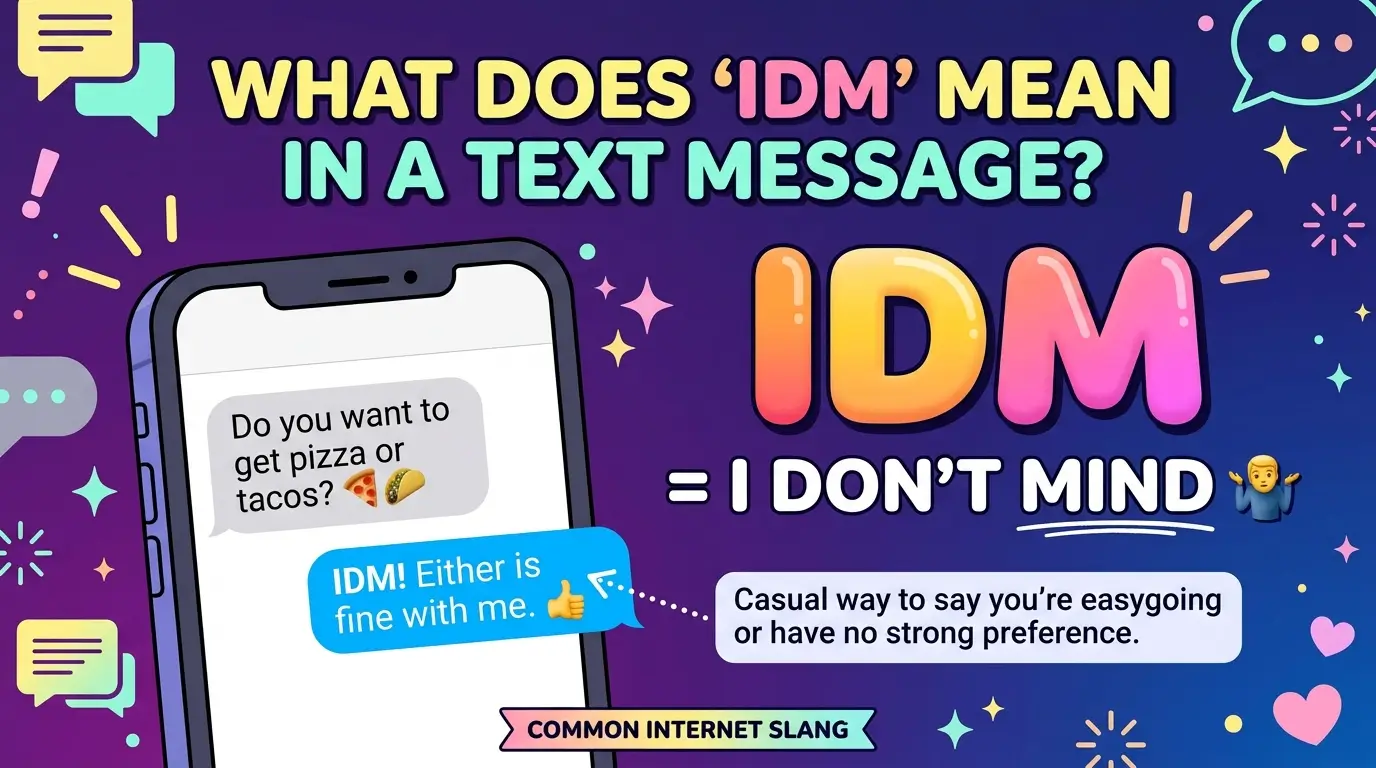
If someone sends you a message containing “IDM”, you may wonder what they are trying to say. Internet slang can be confusing because the same short form may have different meanings depending on the conversation. When people use IDM meaning in text, they are usually asking what these three letters stand for and how they should be understood in a chat.
In most casual conversations, IDM means “I Don’t Mind.” It is a simple way of saying that you are okay with something, that you have no strong preference, or that you are comfortable with another person’s choice.
For example, if a friend asks, “Do you want pizza or burgers?” and you reply, “IDM,” you are basically saying, “I don’t mind. You can choose.”
Although “I Don’t Mind” is the most common meaning in everyday texting, context is still important. The abbreviation can mean something different in technology, business, gaming, or other specialized conversations. This guide explains the common meaning of IDM in text, how people use it, what it means in different situations, and how you can reply naturally.
What Does IDM Mean in Text?
The most common IDM meaning in text is “I Don’t Mind.”
People use IDM when they do not have a strong preference about something. Instead of typing the complete phrase “I don’t mind,” they shorten it to three letters to make the conversation quicker.
For example:
Person 1: “Should we watch a movie or play a game?”
Person 2: “IDM.”
Here, the second person is saying that either option is fine.
IDM can also communicate that someone is not bothered by a particular situation.
Friend: “Is it okay if I bring my brother?”
You: “IDM.”
This means that you are comfortable with the brother coming along.
The phrase is generally casual, so it is most common in text messages, social media chats, gaming conversations, and messages between friends.
Why Do People Use IDM?
Texting has changed the way people communicate. Instead of writing complete sentences every time, people often use abbreviations to make conversations faster.
IDM is useful because it expresses a complete idea in only three letters.
Typing “I don’t mind” takes more time than typing “IDM,” especially during a quick conversation. When the meaning is already clear from the context, the shorter version feels natural.
People may use IDM when:
- They have no preference.
- They are happy with either option.
- They do not want to make the decision.
- Something does not bother them.
- They want to keep a casual conversation short.
The abbreviation is especially useful when two people are discussing simple choices.
Examples of IDM in Text Messages
Understanding examples is one of the easiest ways to learn internet slang.
Imagine your friend asks:
“Do you want to meet at 5 or 6?”
You could answer:
“IDM, whichever works for you.”
Here, IDM means that you are flexible about the time.
Another example:
“Can I call you later tonight?”
“IDM.”
In this case, you are saying that you do not have a problem with the person calling later.
Here is another conversation:
“Should I send the file now or tomorrow?”
“IDM, send it whenever you’re free.”
Again, IDM means that either option is acceptable.
These examples show why context matters. The abbreviation does not describe a specific object or action. Instead, it expresses the person’s attitude toward a situation.
IDM Meaning in Different Conversations
Although “I Don’t Mind” is the most common interpretation, the exact feeling behind IDM can vary slightly depending on the conversation.
IDM as “I Don’t Mind”
This is the standard meaning in casual texting.
Someone may use it when they genuinely have no preference.
For example:
“Tea or coffee?”
“IDM.”
The person is happy with either drink.
IDM as “It Doesn’t Matter to Me”
Sometimes IDM has almost the same practical meaning as “It doesn’t matter to me.”
For example:
“Do you want the blue one or the black one?”
“IDM.”
The speaker is not particularly concerned about which option is selected.
IDM as “I’m Okay With It”
In some conversations, IDM communicates acceptance.
For example:
“Would it be okay if we invited Sarah?”
“IDM.”
The person is saying that Sarah joining is fine.
The exact wording changes, but the basic idea remains the same: the person is not opposed to the situation.
Is IDM Rude in Texting?
Generally, IDM is not rude. However, the way it is used can sometimes make a message sound short or uninterested.
For example, if someone spends a lot of time asking you about your preference and you simply respond with “IDM,” they might think you are not very interested in the conversation.
Compare these two replies:
“IDM.”
and
“I don’t mind, you can choose 😊.”
Both communicate a similar idea, but the second response sounds warmer.
This is why tone matters in texting. Short abbreviations are convenient, but they do not always communicate emotion clearly.
If you want to sound friendly, you can add a few words after IDM.
For example:
“IDM, whatever you prefer.”
“IDM, both sound good.”
“IDM 😊 you choose.”
These responses make your meaning clearer and friendlier.
IDM in Social Media
IDM is also used on social media platforms where people communicate through short messages.
You may see it in Instagram DMs, Snapchat messages, Facebook chats, Discord conversations, or other messaging platforms.
For example, someone might ask:
“Should I post this picture today or tomorrow?”
A friend might reply:
“IDM, both are good.”
The abbreviation works well because social media conversations are usually informal.
However, it is not normally appropriate for formal communication. If you are writing to a teacher, employer, customer, or business contact, writing “I don’t mind” is usually clearer and more professional.
IDM in Gaming Chats
Gamers frequently use abbreviations because gaming conversations can move quickly.
During a multiplayer game, a player might ask:
“Which map should we play?”
Another player could answer:
“IDM.”
That means they are happy to play whichever map the group selects.
A similar situation might happen when deciding roles:
“Do you want support or damage?”
“IDM.”
The player does not have a strong preference.
Gaming communities often develop their own vocabulary, so it is always useful to look at the surrounding conversation before deciding what an abbreviation means.
How to Reply When Someone Says IDM
If someone sends you “IDM,” you usually do not need to ask what they mean if the context is clear.
You can simply make the decision yourself.
For example:
Friend: “Pizza or burgers?”
You: “Let’s get pizza.”
If you want to confirm their meaning, you can ask:
“So you’re okay with either?”
They can then confirm what they meant.
When IDM means “I Don’t Mind,” a natural response might be:
“Okay, let’s go with pizza.”
or
“Cool, I’ll choose then.”
The response depends on what you were discussing.
IDM vs. IDK: What’s the Difference?
People sometimes confuse IDM with IDK because both are common texting abbreviations.
They have completely different meanings.
IDM means “I Don’t Mind.”
IDK means “I Don’t Know.”
Consider these examples.
“Do you want Chinese food or pizza?”
“IDM.”
The person has no preference.
But:
“What time does the restaurant close?”
“IDK.”
The person does not know the answer.
Remembering this difference can prevent confusion during conversations.
IDM vs. IDC: What’s the Difference?
Another abbreviation that can be confused with IDM is IDC.
IDM means “I Don’t Mind.”
IDC usually means “I Don’t Care.”
Although these phrases can sometimes appear similar, they can have different emotional tones.
“I don’t mind” usually sounds neutral or accepting.
“I don’t care” can sound dismissive, depending on the situation.
For example:
“Do you want to watch a comedy or an action movie?”
“IDM.”
This sounds like the person is happy with either option.
But:
“Do you want to watch a comedy or an action movie?”
“IDC.”
This may sound like the person is uninterested in making the decision.
For this reason, IDM is often a softer expression than IDC.
Is IDM Always a Texting Abbreviation?
No. IDM can have completely different meanings outside casual texting.
In technology, IDM can refer to Internet Download Manager, a popular download-management application.
In other professional or technical fields, IDM may represent different terms.
This is why you should never assume that an abbreviation has only one meaning. The surrounding words and subject of the conversation usually tell you what the sender means.
If someone sends you:
“IDM, that’s fine.”
they are almost certainly using the casual “I Don’t Mind” meaning.
If someone says:
“Install IDM to manage the download.”
they are probably referring to Internet Download Manager.
Context solves the confusion.
When Should You Avoid Using IDM?
Although IDM is perfectly normal in casual messages, there are situations where writing the full phrase is better.
Avoid using IDM in formal emails, business proposals, academic writing, official documents, and professional customer communication unless you are certain the reader understands it.
Instead of:
“IDM, you can choose.”
write:
“I don’t mind; you can choose.”
The complete phrase is clearer and more professional.
Using simple language is especially important when communicating with someone who may not be familiar with internet abbreviations.
Why Text Abbreviations Are So Common
Text abbreviations have become a normal part of digital communication. People communicate through smartphones every day, and quick conversations often favor shorter expressions.
Abbreviations such as LOL, BTW, OMG, IDK, IDC, and IDM allow people to express common ideas quickly.
They also make messages feel more casual.
However, abbreviations are not a replacement for normal language in every situation. They work best when both people understand the style of communication.
A good rule is to match the language you use to the person and situation.
Frequently Asked Questions About IDM Meaning in Text
What does IDM stand for in texting?
In most casual conversations, IDM stands for “I Don’t Mind.” It means the person has no strong preference or is okay with the situation.
Does IDM mean “I Don’t Matter”?
No. In normal texting, IDM generally means “I Don’t Mind.” It should not normally be interpreted as “I Don’t Matter.”
Is IDM positive or negative?
IDM is usually neutral or positive. It commonly means that the person is comfortable with the options available.
Can IDM mean something else?
Yes. Context matters. In technology, IDM can refer to Internet Download Manager. Other industries may use the abbreviation for different terms.
Is it okay to use IDM with friends?
Yes. IDM is commonly used in casual texting, social media messages, gaming chats, and conversations with friends.
Is IDM professional?
It is better to avoid IDM in formal communication. Writing “I don’t mind” is clearer and more appropriate in professional situations.
Final Thoughts
Understanding idm meaning in text is simple once you know the context. In most casual conversations, IDM means “I Don’t Mind.” People use it when they have no strong preference, are comfortable with a choice, or want someone else to decide.
For example, if a friend asks whether you want coffee or tea and you reply “IDM,” you are saying that either choice is fine.
The abbreviation is short, convenient, and common in casual digital conversations. Still, it is important to remember that IDM can have other meanings in technical and professional settings. Internet Download Manager is one well-known example.
When you see IDM in a message, look at the words around it and consider the subject of the conversation. Context will usually make the intended meaning obvious.
If you’re chatting with friends, “IDM” is a perfectly natural way to say that you don’t mind. In formal situations, however, spelling out “I don’t mind” is usually the safer and clearer choice.