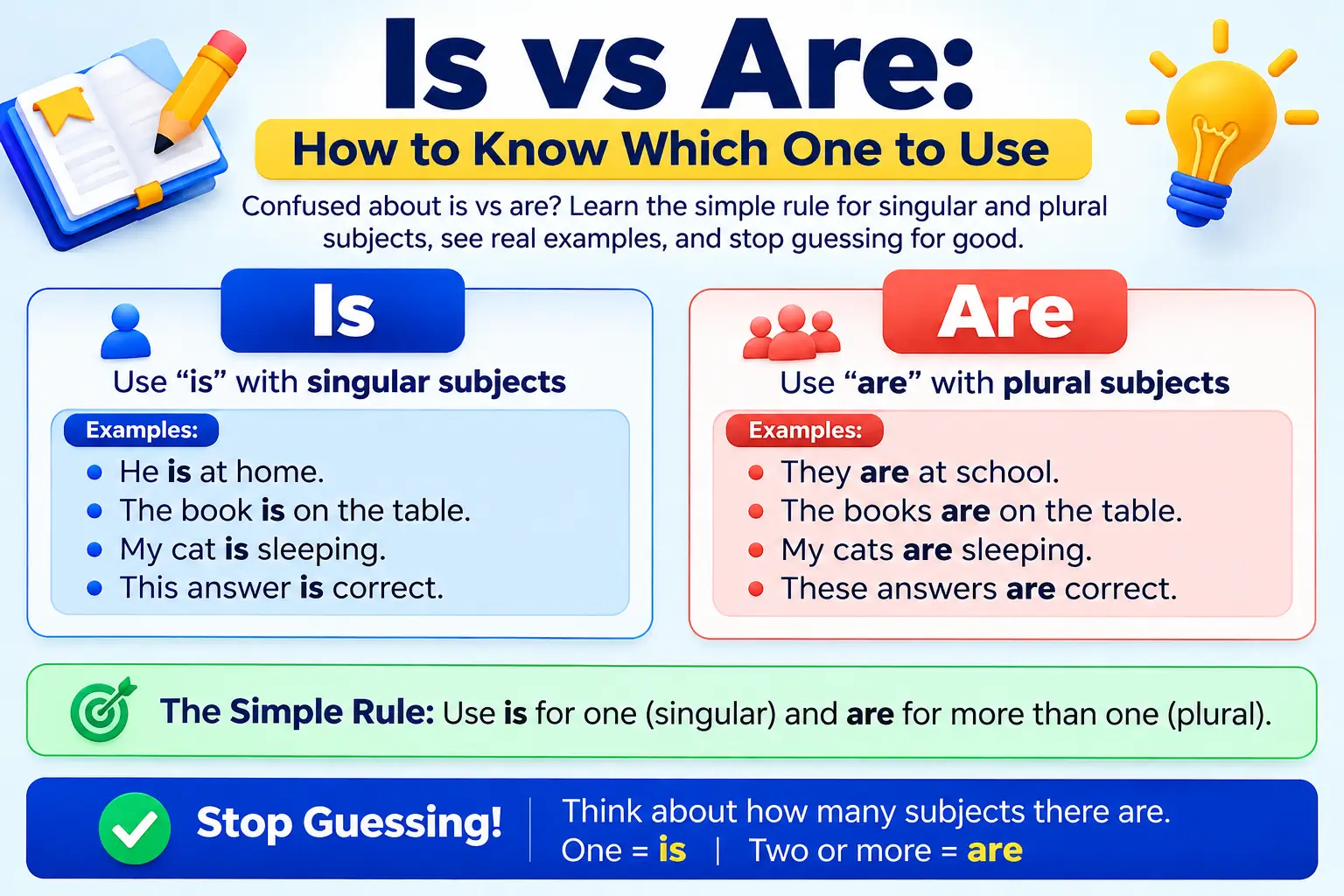
Is goes with one person or thing. Are goes with more than one, and with the word “you.” That one rule solves almost every mix-up between these two words. Below you will see the rule broken down, plus real examples for the tricky cases that trip people up.
The Simple Rule
English verbs change based on the subject. “Is” and “are” are both forms of the verb “to be.” The choice depends on how many people or things you are talking about.
- Use “is” with one person or thing (he, she, it, the dog, my car)
- Use “are” with more than one person or thing (they, we, the dogs, my parents)
- Use “are” with “you,” even when you mean just one person
Examples That Follow the Rule
| Subject | Correct verb | Example sentence |
|---|---|---|
| He | is | He is running late. |
| She | is | She is my sister. |
| The book | is | The book is on the table. |
| They | are | They are my neighbors. |
| The books | are | The books are on the shelf. |
| You | are | You are doing great. |
Tricky Cases
Words That Sound Plural but Are Not
Some words look like more than one thing but actually act as a single unit. Use “is” with these.
- The news is on at six.
- Mathematics is my favorite subject.
- Ten dollars is too much for this.
In the last example, “ten dollars” is treated as one amount of money, not ten separate dollars. That’s why it takes “is.”
Two or More Things Joined by “And”
When two subjects are joined by “and,” they usually become plural together, so you use “are.”
- My mom and dad are coming to visit.
- Bread and butter are on the table. (two separate items)
Some pairs act as one idea and take “is” instead, like “bread and butter” when it means a single dish. Context decides, so read the sentence carefully.
“There Is” vs “There Are”
This is one of the most common mistakes. Look at what comes after “there,” not the word “there” itself.
- There is a cat in the yard. (one cat)
- There are three cats in the yard. (three cats)
Words Like “Everyone” and “Everybody”
Words like everyone, everybody, someone, and nobody sound like they mean a group, but grammar treats them as singular. Use “is.”
- Everyone is welcome at the party.
- Nobody is home right now.
A Quick Way to Check Yourself
Ask one question: can I replace the subject with “he,” “she,” or “it”? If yes, use “is.” Can I replace it with “they” or “we”? If yes, use “are.” This trick works for almost every sentence you will write.
According to the Purdue Online Writing Lab, subject-verb agreement is one of the most common grammar issues writers face, which is exactly why this rule is worth memorizing.
Frequently Asked Questions
Is it “you is” or “you are”?
Always “you are.” This is true whether “you” means one person or many people.
Why do we say “is” for “the news” if news sounds plural?
“News” is what’s called an uncountable noun. It represents one idea or category, not separate countable items, so it takes a singular verb.
Is “my family is” or “my family are” correct?
In American English, “my family is” is standard because the family is treated as one unit. In British English, “my family are” is also common when talking about the individual members.